The classic mistake when packing for Namibia is to picture a single kind of weather. You see the dunes, you think heat, you stack up the T-shirts. Then comes the morning you are hunting for your binoculars before sunrise in Etosha, wrapped in a blanket, or the late afternoon in Swakopmund when the Atlantic wind reminds you that a well-placed windproof jacket can do more for morale than a safari hat, even if it looks less good in photos.
The short answer: pack in layers, bring two pairs of shoes you have already worn in and a small, well-organised day bag, then add extra modules only if your route calls for them: safari, camping, hiking or a light-aircraft flight.
At a glance
- Clothing: a light shirt, a thin fleece and a windproof jacket. According to the Namibia Tourism Board, winter nights (May to September) can drop below freezing, even after a warm afternoon.
- Electricity: type D and M sockets with three round pins, on 220 V and 50 Hz. Bring a compatible adapter and ask your car-hire company which sockets the vehicle has.
- Light aircraft: on its scheduled circuit from 1 May to 30 November 2026, FlyNamibia Safari limits luggage to 20 kg per person, all inclusive, in a soft bag with no wheels or frame. Other flights apply their own rules.
- Health: malaria risk is concentrated in the north and north-east of the country, and the CDC reports no transmission in Windhoek. Prevention is a decision to make with a doctor, with your route map in hand.
- Before you fill the bag: ask your accommodation, car-hire company and guide what they provide. Their answer often takes more out of the bag than it adds.
The right luggage, then, is not the biggest. It is the one that lets you find a warm layer, a water bottle or a cable without emptying the whole boot onto the roadside. Here is a method for packing around your route, your season and the way you travel, without turning every stop into a house move.
Before the checklist, sketch your actual trip
Start with four questions. Will you mostly sleep in lodges, at campsites or a mix of both? Will you have a hire car for several days? Does your plan include walks, early-morning game drives or a trip to the coast? And how often will you be able to do laundry? The answers matter more than any universal list found online. Add a fifth if it applies to you: will any leg be flown in a light aircraft? That one decides the very shape of your luggage.
Someone linking Windhoek, Sossusvlei, Swakopmund and Etosha passes through several moods: dry air and dust on the road, strong light in the desert, cool coastal air, then sometimes very early starts to watch wildlife. Namibia asks you to pack for changing landscapes, not just for the weather. If you are still unsure about the order of your stops, start with our guide Your first trip to Namibia: from ideas to an itinerary. A suitcase becomes much simpler once the route stops being abstract.
The rule that saves space: pack layers that work together, not a complete outfit for each day. A light shirt, a thin fleece and a windproof jacket cover far more situations than three garments chosen separately.
The three-layer system, from desert to coast
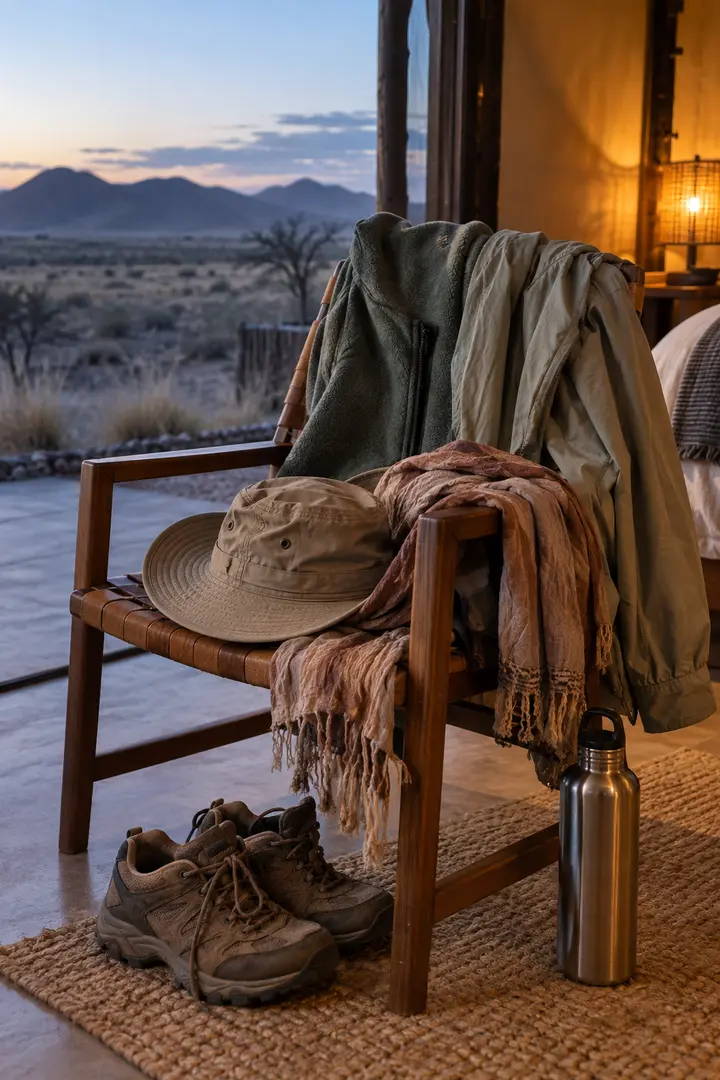
For daytime, choose light, breathable clothes that are comfortable during long hours in a car. One or two long-sleeved shirts protect you from sun and dust without having to reapply sunscreen to your arms every hour. Add T-shirts, two comfortable pairs of trousers or shorts and underwear that dries quickly. Neutral colours are handy on safari, but there is no need to rebuild your wardrobe in beige: comfort and discretion matter more than dressing up for the part.
Your second layer needs to stay within reach. A thin fleece or a warm jumper is often enough to handle a pre-dawn start, an evening outdoors or a sudden drop in temperature. The third layer is a light jacket that cuts the wind. It is especially useful on the coast and in an open vehicle.
The climate guidance from the Namibia Tourism Board supports this approach. The tourism board describes pleasant winter days (May to September), but notes that temperatures can then fall below freezing. It mentions possible freezing nights in the Namib Desert, and a coast cooled by the Benguela Current, with frequent fog in the morning and late afternoon. These are trends, not a forecast: also ask your accommodation what temperatures it is actually seeing in the week before you arrive. If you have not yet settled on a month, our article When to visit Namibia: choosing your season and route helps you weigh heat, rain and cold nights before you think about clothes.
Finally, pack one smarter, simple, crease-resistant outfit if you enjoy eating out or spending an evening in town. Most of the time there is no need to dress as if for a reception: clean, comfortable and suited to the place is perfectly fine.
Two pairs of shoes beat one heroic pair
The best shoe is the one your foot already knows. Taking brand-new hiking boots to break them in on the rocks of the Naukluft is certainly educational, but rarely the lesson you were hoping for. For a classic route, one closed pair with a stable sole covers short walks, dusty tracks and sightseeing. Pair it with sturdy sandals or light shoes for the lodge, the campsite shower and the end of the day.
A demanding hike, particularly in the south, changes the specification entirely: ankle support, sole, suitable socks, blister protection and the ability to carry water. Before you buy anything, ask the guide or organiser about the terrain, the actual duration, the elevation gain, what you will carry and what equipment is provided. Send them that list in writing: their answer is worth more than advice from a shop assistant.
The small day bag: your control centre
The main bag can stay in the boot or at your accommodation. The small one has to follow you without becoming a burden. Aim for a comfortable bag that holds a water bottle, a warm layer, sun protection, key documents, a power bank and a small first-aid kit. A soft bag is often easier to slip into a vehicle than a rigid one bristling with straps and gadgets.
- On top: sunglasses, hat, lip balm, tissues and sunscreen.
- In a protected pocket: phone, power bank, short cable, memory cards and an offline copy of your bookings.
- Within reach: thin fleece or windproof jacket, not under four days of laundry.
- In a separate pouch: personal medication, plasters and products chosen with a health professional.
Add an empty pouch to keep anything dusty, damp or sandy apart from the rest. It seems a modest detail when you are packing at home; after a day on gravel roads, it suddenly looks like a stroke of genius.
Hard suitcase or soft bag: check the light aircraft first
On a self-drive trip, both formats work. A hard case protects fragile items better; a soft bag fits more easily into a boot already holding a cool box, a spare wheel or camping gear. Choose according to what you are carrying and the real space in the vehicle, not out of habit.
The question can become a hard constraint as soon as a light aircraft enters the plan. On the information page for its scheduled fly-in safari circuit, consulted on 4 October 2026, FlyNamibia Safari sets a maximum of 20 kg per person for the season from 1 May to 30 November 2026, including hand luggage and camera equipment. Luggage must be a soft bag with no internal or external frame, no telescopic handle and no wheels. This rule applies to that service and that season: a scheduled domestic flight, another operator or a private charter applies its own conditions, which you should read on your ticket or have confirmed in writing.
If your trip combines road and air, pack the flying part in a soft bag weighed at home, camera included. Then ask your agency, car-hire company or departure accommodation whether you can leave the rest behind, and on what terms. Our guide to preparing a trip between Namibian towns covers the questions to ask before a domestic flight or a shuttle.
Safari: see more without carrying a photo studio
Binoculars genuinely change the experience: they let you watch without trying to close the distance to the animal. If you are travelling as a pair, ask yourselves whether one pair will be enough during a long wait at a waterhole. Sharing is a fine value, but it sometimes reaches its limits when an elephant appears on the far side of the pan.
For photography, start with the camera you already know how to use. Bring batteries, a charger, memory cards, a soft cloth and dust protection. Avoid changing lenses in the middle of a gust of sand. A simple dry bag or a fitted cover also protects your gear during transfers. If you shoot on your phone, free up space before you leave and turn on backups whenever you have a connection. And if a light-aircraft flight is planned, weigh the camera bag with everything else: it counts towards the limit.
A guided safari may provide blankets, water or binoculars, but nothing is automatic. Before booking, ask about the departure time, duration, type of vehicle, maximum group size and what is included. To picture the rhythm of a day there, read our Etosha first-trip guide, then browse safari provider listings on Ayivoo and put these questions to two or three of them.
Self-drive: what stays in the cabin
On the road, how you split your things matters almost as much as what you carry. Keep water, snacks, a jacket, sunglasses, the details of your next stop and offline maps in the cabin. Pack the rest so that you do not have to open every bag at each stop. A head torch is useful at the campsite, but also when you are searching the boot after sunset.
As for electricity, Namibian wall sockets are types D and M, with three round pins, on a 220 V, 50 Hz supply, according to the UK charity Electrical Safety First. An adapter that covers both formats spares you a bad surprise on the first evening; also check that your chargers accept 220 V. Some places have other sockets, and some limit power to certain hours: ask rather than assume.
Bring cables that match your devices and ask your car-hire company which sockets are available in the vehicle. A cigarette-lighter or USB adapter can be useful, but the right model depends on the actual equipment. The same logic applies to vehicle gear: do not improvise your own roadside repair kit at random. Ask instead which tyres, tools, spare wheels and assistance are provided, then have someone show you how to use them before you leave the depot.
Our guide Sossusvlei: safety and logistics covers useful habits on gravel roads and around the park. Once your route is set, you can also find 4×4 hire companies on Ayivoo and send each of them exactly the same questions: model offered, tyres, assistance, driving restrictions and equipment included. A listing tells you who to contact; it does not tell you what is still free on your dates.
Camping: add a module, not a second home
Camping calls for a few specific items: a head torch, a small backup lamp, a quick-drying towel, sandals, a laundry bag, warm clothes for the night and perhaps a sleep mask. But a tent, bedding, table, chairs, cool box, stove and cooking utensils may be included in the rental. The only reliable checklist is therefore the one you get after going through the inventory with the hire company.
Ask to see how the tent goes up and pitch it once yourself before you leave. Also check how the fridge or cool box works, where the cooking gear is stored and what has to be returned clean. That quarter of an hour saves you a first night-time set-up that feels like a logic puzzle solved by headlight.
To plan your stops, look for campsites among Ayivoo accommodation listings and ask each place you shortlist three simple questions: are there toilet and washing facilities on site, is there access to electricity, and what is the latest check-in time? In remote areas, a late arrival is not always possible.
Hygiene, health and sun: be precise without playing doctor
Carry your usual medication in its original packaging, with whatever documents your situation requires. Add a small kit put together for your route with advice from a health professional: plasters, antiseptic, blister care and products you know how to use. Health recommendations vary by region, season, activity and traveller; check them shortly before departure with the relevant authorities and your doctor.
For sun and dry air, pack sunscreen, a wide-brimmed hat, good sunglasses, lip balm and moisturiser. A reusable water bottle is still useful, but do not take tap water for granted: the French foreign ministry's travel advice recommends drinking only sealed bottled water or water made safe by filtering, boiling or a disinfecting product. Ask at each stop what your accommodation provides or recommends.
For malaria, what matters is the map of your route, not a desert photo. The US CDC, on its page reviewed on 25 August 2026, places transmission in the regions of Kavango East and West, Kunene, Ohangwena, Omaheke, Omusati, Oshana, Oshikoto, Otjozondjupa and Zambezi. It considers transmission rare elsewhere and absent in Windhoek. The French advice, updated on 15 September 2026, also describes the north and north-east, with a higher risk in the rainy season, but includes only the north-eastern parts of Otjozondjupa and Omaheke and does not mention Kunene. The two lists therefore do not match word for word. If your route heads up to Etosha, Kavango or Zambezi, show it to a doctor or a travel health clinic: it is for them to decide on repellent, covering clothing and any preventive treatment.
Documents and digital: a copy that works offline
Carry your passport, driving licence, contracts, insurance and confirmations as required at the time of travel. Entry rules can change, so check official sources before you leave. Keep an encrypted digital copy and an offline version of everything you will need on the road: the address of your first accommodation, the car-hire company's contact details, your bookings and assistance numbers.
Download your maps before leaving Wi-Fi and pin every accommodation. A business name alone is not always enough to find an entrance on a gravel road. Ask whether the property provides GPS coordinates, a landmark or access directions. On a long driving day, that detail is worth more than a new app installed the night before.
A modular checklist rather than an endless list
| In every case | Add depending on the trip | Confirm before packing |
|---|---|---|
| Light layers, fleece, windproof jacket, hat, sunglasses, water bottle | Swimwear, light towel, sandals, warmer clothes | Night-time temperatures and laundry options |
| Worn-in shoes, small day bag, sun protection | Hiking boots, poles, rain protection | Terrain, load to carry and equipment provided by the guide |
| Phone, cables, power bank, type D and M adapter, offline documents | Camera, binoculars, memory cards | Vehicle sockets, power at the lodge, binoculars provided |
| Luggage suited to the journey | Soft bag with no wheels or frame for a light-aircraft flight | Maximum weight, required bag type and whether camera gear counts, depending on the air operator |
| Personal medication and a suitable kit | Repellent or specific items advised | Current official and medical health recommendations for the regions you cross |
The message to send before you zip up the bag
A week before departure, send this message to your accommodation, guide or car-hire company:
Hello, we arrive on [date] and are planning [activity]. Could you tell me the usual morning and evening temperatures, what equipment you provide, any luggage limits, the options for charging devices and doing laundry, and which shoes or clothes you currently recommend? Thank you.
The reply often takes more out of the suitcase than it puts in. It also stops you buying equipment that is already provided or, the other way round, finding out too late that a warm layer should have stayed in your day bag. Keep it in writing: it is a good guide for packing; what the hire company or accommodation is actually bound to depends on your contract and booking terms, and nobody can guarantee the weather.
Final sort: the bed method
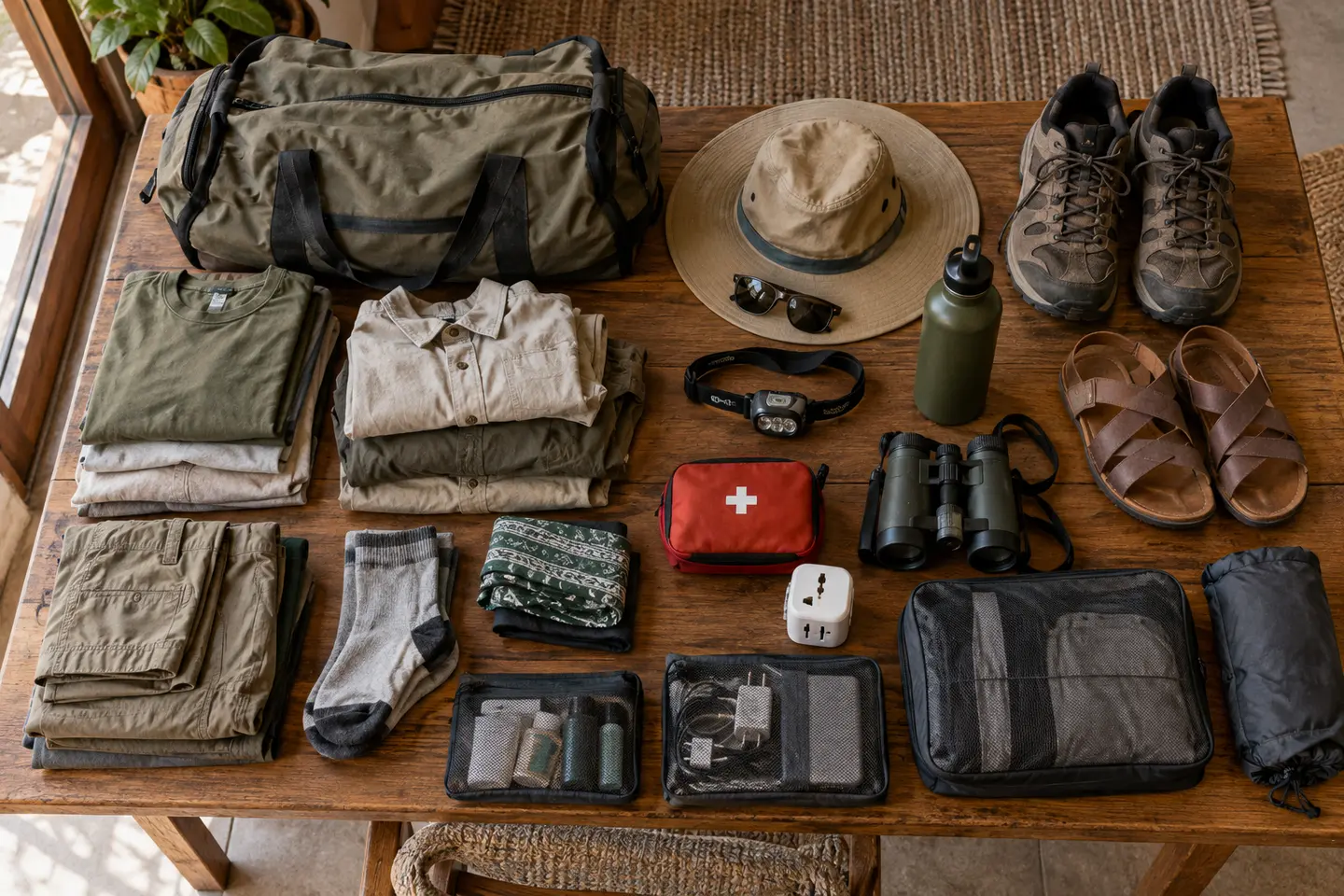
Here is what I would do. Lay everything out on the bed, then remove the duplicates before filling the bag. Put together one complete outfit for a cold morning, a hot day and a stop on the coast. Add the modules you need — safari, camping, hiking, light aircraft — only after checking what providers supply and what operators allow. Finally, leave a little space free. It will hold road-trip groceries, a carefully chosen souvenir or simply the rare pleasure of closing a bag without sitting on it. The goal is not to carry everything; it is to be ready for what your route actually holds.
Once your list is refined, keep the message above handy for each accommodation, hire company or guide you choose. A good exchange before departure is often worth more than a kilo of “just in case” equipment.
Frequently asked questions before you close the suitcase
Which plug adapter do I need for Namibia?
Namibian wall sockets are types D and M, with three round pins, on a 220 V, 50 Hz supply, according to Electrical Safety First. An adapter covering both formats is enough if your chargers accept 220 V. To charge in the car, ask the hire company which sockets the vehicle has.
Do I need a soft bag rather than a hard suitcase?
For a self-drive trip it is not required, although a soft bag is easier to stow. For a light-aircraft flight it can be compulsory: on its circuit for the season from 1 May to 30 November 2026, FlyNamibia Safari requires a soft bag with no wheels or frame and 20 kg per person, all inclusive. Other flights have their own conditions, to be checked on your ticket.
Do I need to protect myself against malaria in Namibia?
It depends on the regions you cross and the season. The CDC (page reviewed on 25 August 2026) and the French travel advice (updated on 15 September 2026) place the risk in the north and north-east, with lists of regions that do not match exactly; the CDC reports no transmission in Windhoek. The decision on prevention belongs to a doctor, based on your route.
Can I drink the tap water?
The French foreign ministry's travel advice recommends drinking only sealed bottled water or water made safe to drink. Bring a water bottle and ask each accommodation what it provides or recommends; do not assume one stop's water is safe because another's was.
Does it really get cold at night?
In winter, from May to September, the Namibia Tourism Board says temperatures can fall below freezing and that nights in the Namib Desert can be bitterly cold. A fleece and a windproof jacket within reach in your day bag are often enough for pre-dawn starts; for camping, ask the hire company how warm the bedding it provides really is.
Is camping gear included with a hired 4×4?
Sometimes, but not as standard. A tent, bedding, cool box, stove and utensils may or may not be included, depending on the hire company and the contract. Ask for a written inventory before you leave and pitch the tent once at the depot.
Sources and date last checked
- Namibia Tourism Board, “Climate”: seasons, winter nights, coast and fog. Undated page, consulted on 4 October 2026.
- FlyNamibia Safari, “Info” page: 20 kg all inclusive, soft bag, season from 1 May to 30 November 2026. Consulted on 4 October 2026; applies to this service only.
- Electrical Safety First, travel adaptor for Namibia: D and M sockets, 220 V, 50 Hz. Specialist UK source, consulted on 4 October 2026.
- CDC, Namibia Traveler View: regions affected by malaria. Page reviewed on 25 August 2026, consulted on 4 October 2026.
- France Diplomatie, Namibia, health (in French): malaria and drinking water. Updated on 15 September 2026, consulted on 4 October 2026.
These health rules and luggage conditions can change: read them again in the week before you leave.
AI-generated cover illustration for Ayivoo.