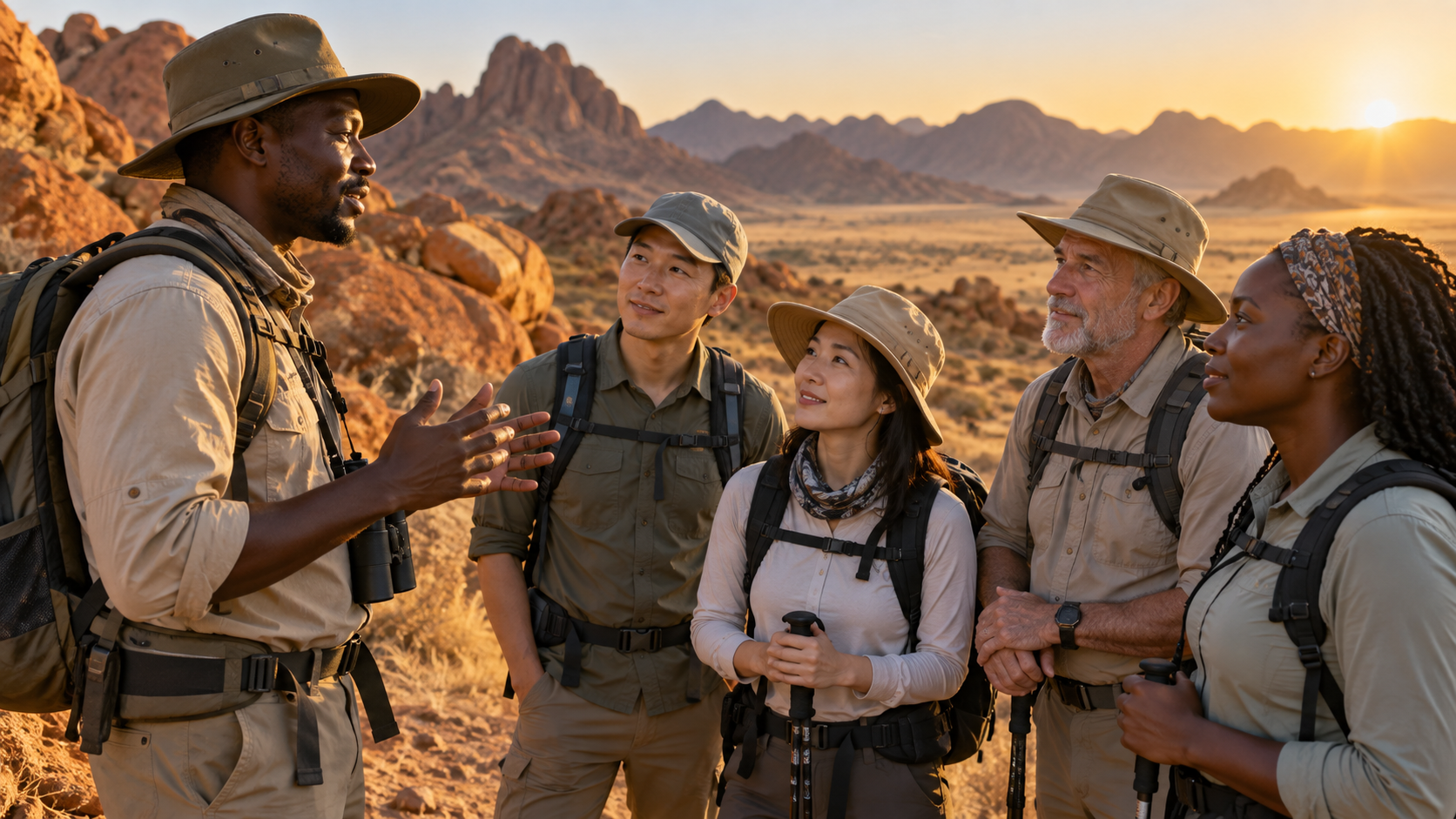
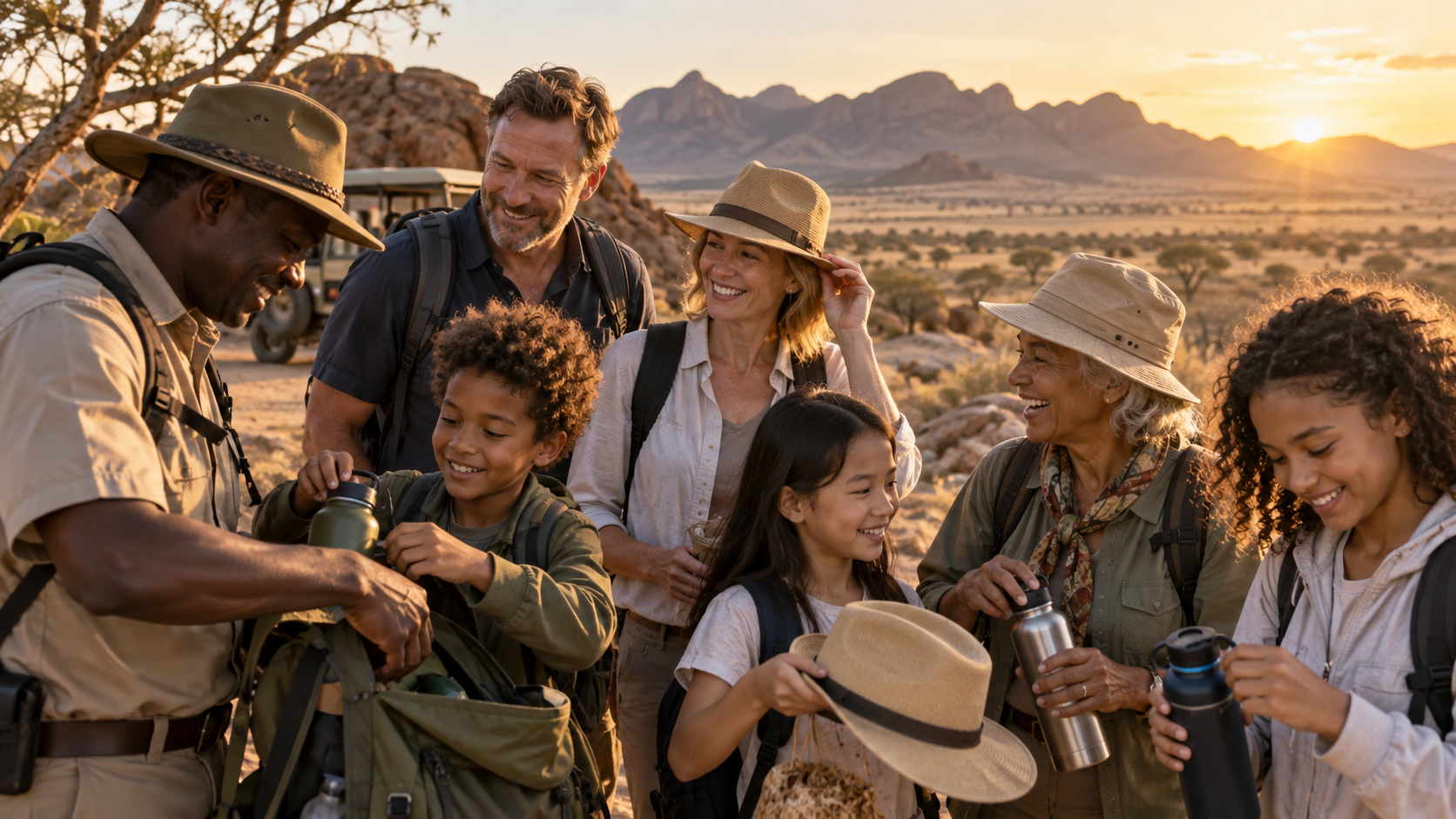
An activity labelled “family-friendly” is not automatically right for your family. Before you book, hold its real duration, pace, heat exposure, transfers, toilets, meals and age rules up against the needs of your youngest child — and against how much energy the adults really have left. In Namibia there is no general age convention: operators set their own conditions, sometimes activity by activity, and some decisions are only made on the day. Ask for the rule in writing, for the exact activity and date. The check takes ten minutes and stops a good idea from turning into an endurance test.
In short
- Give each child’s age and mention the needs that genuinely change the logistics.
- Ask for the operator’s age rule for this specific activity, and who decides on the day.
- Ask for the door-to-door duration, not just the length of the activity itself.
- Check shade, water, toilets, meals, child restraints in the vehicle and whether you can leave early.
- Treat any age, height or fitness limit as a condition, not a detail.
- Agree on a plan B and the cancellation terms before you pay.
Start with the family member who has the least slack
The principle is simple: match duration, pace, food, shade, toilets, transport and safety to the ages and needs of everyone in the family. In practice, a teenager who loves walking, a four-year-old who still naps after lunch and a baby who struggles in the heat will not experience the same outing. Write down your fixed constraints first: nap times, meals, medication, toilet independence, walking ability, a particular fear, a need for quiet or for accessibility. Share only what helps the organisation — nobody needs a full medical history, and sensitive personal details can stay with you.
Then ask the provider what actually happens. How long do you spend in the vehicle? How far do you walk? Does the group wait around at the start? Can you head back early? An appealing title rarely tells you any of this, yet these are the details that decide whether the day stays enjoyable.
The red, amber, green grid
Fill in this grid before you compare two activities. A single unresolved red box is enough to put the booking on hold.
| Level | What goes here | Decision |
|---|---|---|
| Red | Age or height limit, no car seat, exposure incompatible with a health need, no way to leave early. | Do not book until the point is resolved in writing. |
| Amber | Toilets far away, late meal, long stretch in the vehicle, uncertain shade, brisk group pace, participation left to the person in charge on the day. | Ask for an adjustment or prepare a realistic workaround. |
| Green | Flexible break, easy access to water, short stages, a quiet space, compatible timing, a contact you can reach. | These are strengths, not compensation for a red box. |
Age rules belong to the operator, for a given activity
Two documents published by Namibian operators, consulted on 4 October 2026, show why the question has to be asked every time. They are cited to illustrate real rules, not to recommend these operators.
- Namibia Wildlife Resorts (NWR), terms and conditions for tour operators: whether a child under 6 can join a guided activity is at the camp manager’s discretion, so it cannot be booked in advance, and participation is at the parent’s or guardian’s risk. The same terms state that activities cannot be pre-booked during the rainy season (the document does not specify which months).
- Alter Action, sandboarding in Swakopmund: the operator’s page says the youngest children who are confident on their own boards are 10 and over, and that younger children are welcome on the trip but often choose to ride with guides on the faster runs.
The two documents point in different directions. At NWR, an under-6’s participation stays uncertain until the day itself; at Alter Action, younger children are welcome and often ride with a guide on the faster runs. That is exactly what a “family-friendly” label leaves out. The NWR document is written for tour operators: if you book another way, ask which conditions apply to your booking.
One family, several age bands
In the NWR document, the thresholds change depending on what you are booking:
| Item | What the document says |
|---|---|
| Guided activity | Under 6: camp manager’s decision, cannot be booked in advance. |
| Accommodation | Under 6: free; 6 to 12 sharing with a paying adult: 50% of the adult rate; child in their own chalet: adult rate. |
| Meals | Children’s menu for under-12s, which can only be booked on arrival. |
These are terms for tour operators, consulted on 4 October 2026; they may differ for a direct booking and may change before your stay. What matters here is the method: for each child, note the age they will be on the day of the activity, then check the rule for each item you book.
Work out how long the outing really takes
An activity sold as two hours can fill half a day: getting ready, pick-up, the drive, waiting, the briefing, the activity, the return and a delayed meal. Ask what time you actually leave your accommodation and what time you get back. Then add your own margin for dressing the children, filling water bottles, a last trip to the toilet and an unplanned stop.
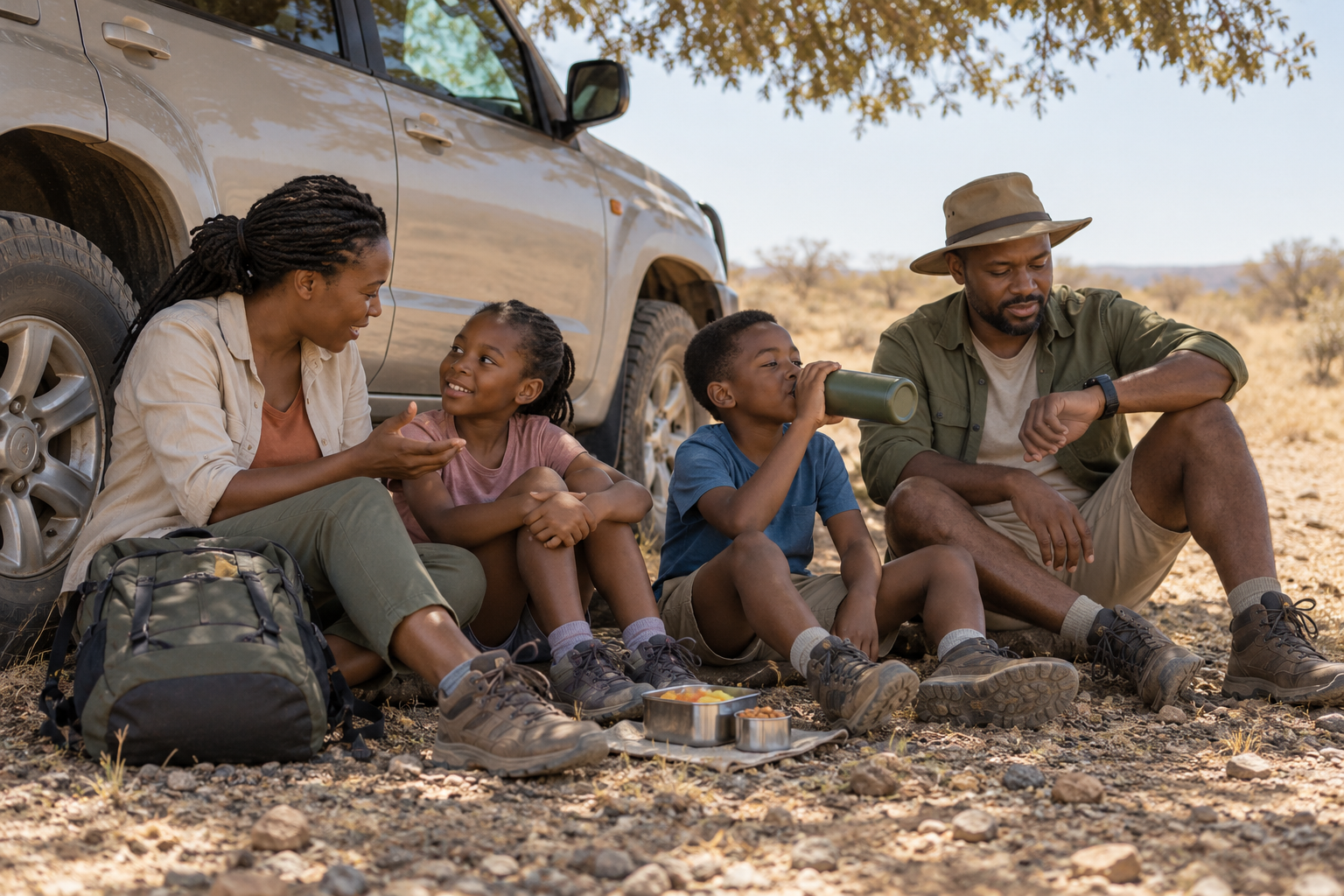
For an outdoor outing, do not assume that “morning” means a comfortable temperature. Ask for the exact departure time, how much of the time is spent in the sun, where the shaded break happens and whether the activity can be moved or shortened. Heat varies a great deal by season and region: the guide to choosing your season in Namibia helps you understand which conditions you are travelling in. Then check the expected conditions the day before.
If you are planning a day of game viewing by car, the first-trip guide to Etosha helps you shape it. Whatever rhythm you choose, adjust it to nap time and to the real patience of the children in the back seat.
Ask questions that can actually be answered
- What is the youngest age you accept for this specific activity, and can you put it in writing?
- Is a young child’s participation confirmed at booking or decided on the day — and by whom?
- How much time is spent on foot, seated and in a vehicle?
- Where are the toilets and when can we use them? Can we get out of the vehicle on the way, and where?
- Who provides water, snacks, sun protection or equipment?
- What restraint is provided for each child during transfers, and is it right for their age and size?
- What happens if a child needs to stop before the rest of the group?
Ask one clear question at a time and keep the answers. A useful reply describes how the day unfolds and admits its limits. “We often host families” tells you nothing about the vehicle, the pace or the fallback plan. If the answer stays vague, rephrase it around your own situation and ask for confirmation point by point.
Prepare a small plan B, not a second holiday
The fallback can be simple: a shorter version, one adult heading back with the child, a shaded spot to wait, a later slot or an indoor activity nearby. Check who handles a possible early return and whether the change costs extra. If nobody can leave the group, that is a significant constraint to know before you set off. When a child’s participation depends on a decision made on the day, plan at the time of booking what the adult who stays with them will do.
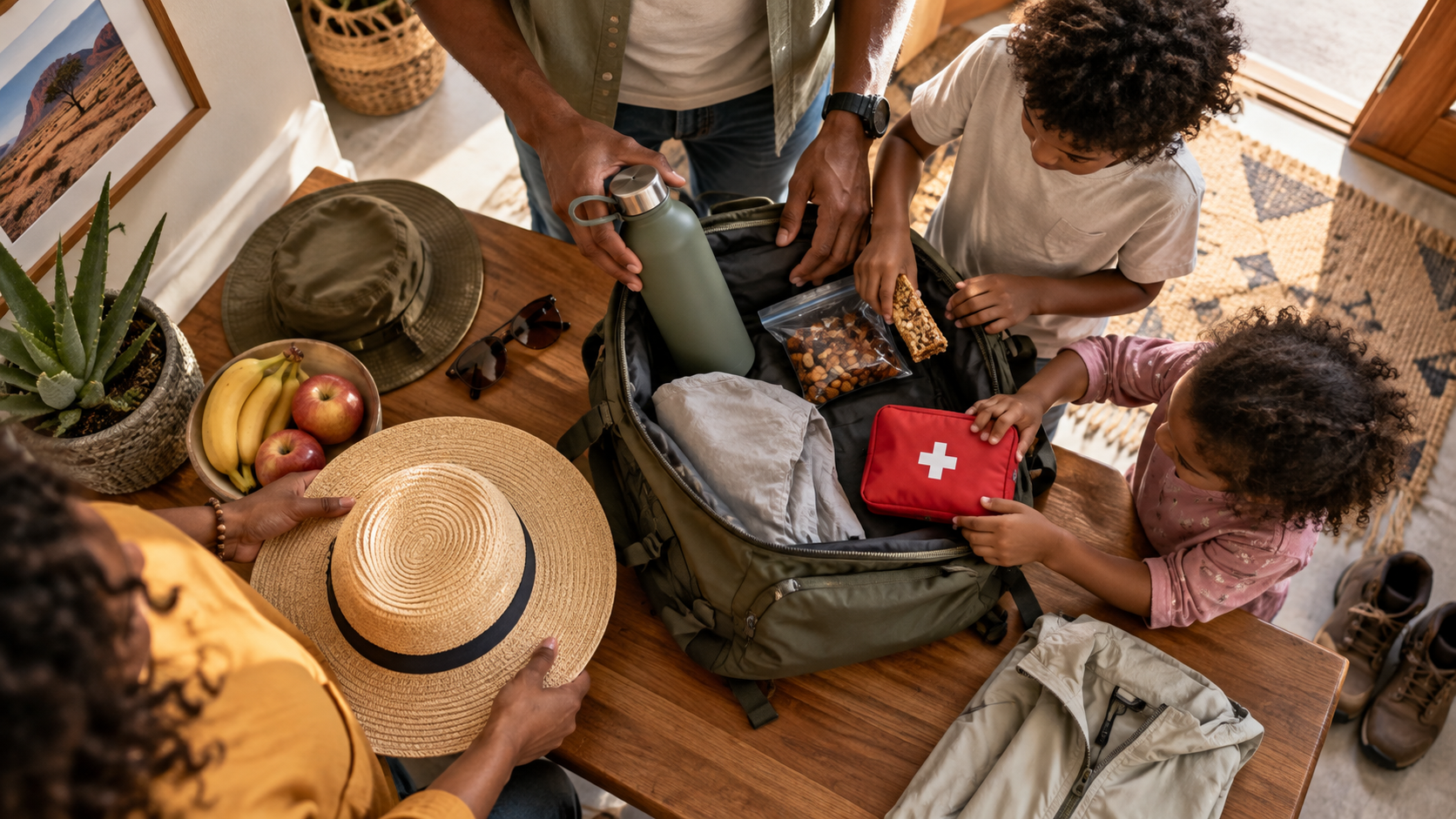
Pack for the needs you have identified rather than counting on equipment being supplied: water, a snack, a hat, sun protection, a change of clothes, any prescribed medication and an offline copy of the meeting details. The Namibia packing checklist helps you put the day bag together. Never give one child’s medication to another, and ask a health professional about any individual health question or anything specific to the region you are visiting.
Use Ayivoo search without reading more into it than it says
On 4 October 2026, the Ayivoo search for tours and experiences in Namibia offered, in its physical-level filter, an option for children (checked in the French interface, where it reads “Adapté aux enfants”). It helps you sort listings; it does not confirm the minimum age accepted, the vehicle’s equipment or availability on your date. If you are staying on the coast, tours and experiences around Swakopmund can help you build a shortlist; for transfers, ask transport providers in Namibia about child restraints. The first-trip guide to Swakopmund helps you spread outings along the coast.
Then send the same questions to every provider and compare how precise the answers are, not just the photos or the title.
Frequently asked questions
From what age is an activity in Namibia suitable for a child?
There is no universal age. The rule depends on the operator and often on the activity. For example, on 4 October 2026 a sandboarding operator in Swakopmund said that the youngest children confident on their own boards were 10 and over, and that younger children were welcome but often rode with a guide on the faster runs. Ask for the written rule, then compare duration, effort, exposure and breaks with what your child can manage.
Can a child under 6 join a guided activity run by Namibia Wildlife Resorts?
According to NWR’s terms for tour operators, consulted on 4 October 2026, this is at the camp manager’s discretion, cannot be booked in advance and is at the parent’s or guardian’s risk. Check the conditions that apply to your own booking.
Should I bring a car seat for a transfer or an excursion?
Ask which vehicle will be used, what restraint is supplied and whether it suits your child’s age and size. Do not read “transport included” as “suitable child seat included”. This article does not set out Namibia’s legal requirements on the matter, because we were unable to consult the regulation in force.
How do I handle a group outing if my child gets tired?
Before you set off, get confirmation of whether there is a shorter version, a safe place to wait or a way back. If there is none, choose an activity whose pace works from the start.
Does Ayivoo’s children filter guarantee that a provider will accept my children?
No. This option in the tours and experiences search helps you sort listings; it does not confirm the accepted age, equipment, price or availability. Ask the provider for a current answer for the activity and date you have chosen.
What this article is based on
Consulted on 4 October 2026. Namibia Wildlife Resorts, Terms and Conditions for Tour Operators, sections 1.1 and 1.4. Alter Action: “Sandboarding” menu, Lie Down Boarding or Stand up Boarding page. Filters of Ayivoo’s tours and experiences search, checked on the French-language interface. No operator was contacted and none is recommended here. This article offers a preparation method, not medical or legal advice; age rules, transport, equipment, prices and weather conditions must be confirmed for the activity and date you choose.
Before you send the first message: note each child’s age on the day of the activity, fill in the three lines — red, amber, green — then add the question “who decides on the day?”. The best activity will be the one that answers all of it clearly.