Before you pay for a guided outing in Namibia, check three things separately: the business selling it, the person who will actually guide you, and the rules of the place you are visiting. The business can be looked up by name or registration number in the official directory of the Namibia Tourism Board (NTB). The person should be able to tell you their guiding language, their training and who will be responsible for first aid on the day. The site may have guides of its own: at Twyfelfontein, some rock-art routes can only be walked with a guide, so the person you booked will not necessarily be the one who interprets the engravings. Pace, group size, the full price and the way the outing treats residents and wildlife come next. Below you will find a three-layer check, a table by type of outing, a message you can send as is, and a way to use Ayivoo search without mistaking it for a booking.
In short
- A polished website or a provider profile does not tell you who will guide you. Ask for a name, a guiding language and a qualification.
- NTB registration applies to the business — tour operator, activity operator, tour facilitator and so on. We found no public register of guides as individuals.
- The 2004 regulations for regulated tourism businesses (GN 138/2004), listed with no amendment in the Legal Assistance Centre’s legal index updated on 15 July 2026, require registered activity and tour operators to have outings led by a trained or experienced person, with a holder of a first-aid certificate present. They do not certify individual guides, and we have not verified how they are enforced in practice.
- Some sites use their own guides for part of their visits, and some activities in national parks are reserved for concession holders authorised by the Ministry of Environment.
- In Etosha, New Era reported on 3 August 2026 that the ministry was defending a restriction on empty safari vehicles entering the park, which some operators were contesting. Ask for written confirmation, for your date, of where and how your guide will collect you.
- Ask for the total price, inclusions, cancellation terms and fallback plan in writing. If an Ayivoo profile shows no price or offer, confirm rates and availability directly with the provider.
Business, guide, site: three checks that cannot stand in for one another
People talk about “booking a guide” as if it meant one person and one agreement. In Namibia, whoever helps you read an engraved rock face, an elephant track in a riverbed in the Kunene region or the comings and goings at a waterhole is almost always working inside a larger structure: a registered business, a lodge, a conservancy (a communal area where residents manage wildlife and tourism themselves), a park concession holder or a heritage site. Each of these answers a different question. Mix them up and you end up reassured by the wrong proof — an association logo when what you needed was a first-aider, or a registration number when the real issue was permission to operate inside a park.
1. The business: a number you can check yourself
Since 1 February 2005, a ministerial declaration (GN 136/2004) has required businesses in sectors designated as regulated to hold an NTB registration certificate. The list includes activity operators, tour and safari operators, tour facilitators, booking agents, shuttle services and vehicle rental companies, among others. The conditions of registration are set out in regulations made under the Namibia Tourism Board Act (GN 138/2004). The NTB’s public directory lets you search for a business by name, region, town, category or registration number.
The check itself takes a minute: ask for the legal name and number under which the outing is sold, then look them up yourself. Two caveats will stop you jumping to conclusions. When we consulted the directory, it had no category for individual guides; a freelance guide may work under the registration of an operator or a lodge, and that is the business you need to identify. And a search that returns nothing does not prove that anything is wrong — a trading name that differs from the legal name is enough to send you down the wrong path. The right reaction is a question, not an accusation.
2. The guide: training, first aid, language
The regulations set concrete requirements, but only for registered businesses in two categories: activity operators and tour operators. The outing must be conducted under the supervision of someone with appropriate training or experience. The operator, or at least one employee, must hold a recognised first-aid certificate and stay with the clients during the outing. For activities, the risks involved must be explained in writing or in a formal briefing. These make good questions because the answers are concrete — a name and a time: “Who holds the first-aid certificate that day? When and where is the briefing?” They do not replace your own judgement about what is being offered.
Namibia also has a national guiding qualification, the Level 4 “National Guide”. Three of its units matter to travellers: first aid and ethical and legal responsibilities, both compulsory, and guiding in a language other than English, which is only an elective. We found neither a public register of these guides nor any rule requiring the qualification for every outing. A qualification mentioned in a message is therefore a lead to follow up: “Which level, and issued by whom?”
Language deserves the same precision, especially if someone in your group is more comfortable in German, French or another language than in English. Fluent messages before the trip do not guarantee commentary in that language out in the field. Ask the question with no grey area: “Will the person guiding us speak [language] for the whole outing, safety briefing included?” “No, but I can give you the safety points in writing” is an honest answer, and often a perfectly workable one.
3. The site: sometimes the choice is not yours to make
Some places have their own guides, and that is generally good news. At Twyfelfontein, a World Heritage Site, the NTB says there are several rock-art routes: some are self-guided, others can only be seen with a guide. For the White Lady in the Brandberg, a specialist source from 2018 described visits led by accredited guides on a walk of roughly 6 km there and back; we have not been able to confirm the current rule with the site. In cases like these, the guide you booked may plan the day, the drive and the pace without necessarily interpreting the site itself. Ask how they work alongside the site guides, and whether entry fees are included.
Protected areas add another layer. The Ministry of Environment, Forestry and Tourism (MEFT) grants concessions that give the right to run certain tourism activities inside parks. In December 2023 it warned that companies without concession rights were advertising activities in the Namib-Naukluft and Tsau //Khaeb parks, and reminded the public that bookings should go through authorised companies. In Etosha, the daily newspaper New Era reported on 3 August 2026 that the ministry was defending a restriction on empty safari vehicles entering the park — a measure the paper said had already been applied in 2018 and 2021. Independent operators said at the time that they could no longer come into the park to collect clients who had booked with them. We do not know whether this restriction will still apply on the day of your visit. That is precisely why, if you are staying at a camp inside the park and booking a guide based outside it, you should get written confirmation, for your date, of the pick-up point and arrangements, and of the plan if the vehicle is refused entry.
What changes from one outing to the next
| Outing | What we checked | The question to ask |
|---|---|---|
| Twyfelfontein engravings | Some routes are self-guided, others only with a guide (NTB). | “Which route will we walk, who will interpret it, and are entry fees included?” |
| White Lady, Brandberg | Guided visits described in 2018 (Travel News Namibia); current rule not verified. | “Is a site guide required today, what time do we set off to walk before the heat, and who brings the water?” |
| Etosha safari | NWR presents its guided day and night drives as offered from its own camps; restriction on empty safari vehicles reported by New Era on 3 August 2026. | “Where and how will you collect us that day, through which gate, and does the night drive take place inside the national park or on a private reserve?” |
| Activity in a concession park (Namib-Naukluft, Tsau //Khaeb) | Some activities are reserved for concession holders (MEFT notice, December 2023). | “What right allows you to run this activity inside the park?” |
| Outing in a conservancy | According to NACSO, in tourism concessions managed by conservancies, 75% of net income typically goes to the conservancy and 25% to the state. | “Does your activity run through a conservancy or a concession, and which one?” |
| Cultural visit, “living museum” | At the Ovahimba Living Museum, no advance booking is possible and payment is in cash against a receipt (operator’s FAQ). | “Who organises the visit, who gets paid, and what are the rules on photos?” |
This table does not rate any provider. Its job is to stop you asking the same generic question everywhere, when the question that actually decides things depends on the place. To fit these bookings around distances and timings, our guides to booking locally in Damaraland and booking locally around Etosha cover entry gates, door-to-door travel times and the margin you need before dark.
Choose the experience before you choose the guide
Two visits to the same place can meet completely different expectations. A family wants breaks, a predictable pace and explanations that children can follow. A photographer wants time, few people and a particular light. Someone passionate about history wants sources and context, and will be disappointed by a tour that “does” three sites before lunch. Before you look for a name, write one sentence describing what would make the outing a success for you.
Then add your limits: maximum duration, mobility, language, comfort, tolerance for heat, dietary needs, particular fears, or a time you absolutely must be back by. In Namibia, the distance between where you are staying and the starting point matters as much as the advertised duration. A “half day” can begin with an hour on a gravel road — beautiful, admittedly, but rarely counted in the brochure. This short brief lets a guide tell you honestly whether their outing suits you. An answer along the lines of “this format isn’t ideal for you, but here’s an alternative” is often an excellent sign of professionalism.
If you are still unsure what kind of experience you want, our overview of the main ways to discover Namibia can help you decide before you start comparing guides.
Six criteria that actually change the decision
| Criterion | Useful question | What to look for |
|---|---|---|
| Identifiable business | Under which legal name and NTB number do you sell this outing? | A number you can find in the NTB directory, or a clear explanation (a guide employed by a named lodge, for example). |
| The actual guide | Who will be there on the day, and in which language will they guide? | A name, a role, a guiding language and a way to get in touch. |
| Local expertise | Which places and topics do you guide regularly? | A precise answer that does not claim to know everything — including “at this site, the local guide does the commentary”. |
| Safety | Who holds the first-aid certificate, what briefing, what equipment, what fallback plan? | A named person and a planned briefing, not vague reassurance. |
| Group size and format | What is the maximum, and is the outing private or shared? | A limit that makes sense for the activity and for your needs. |
| Respect for the place | What rules do you follow on photos, encounters and wildlife, and what access rights do you have? | Consent, distance, concession or partnership explained in plain terms. |
There is also a check you can make on the morning itself. Under the same regulations, a vehicle that a registered business uses on public roads for its clients must display the business’s identification on both sides and the NTB disc, and carry a fire extinguisher and a first-aid kit. An unmarked vehicle is not proof of fraud, but it is worth a question before you climb in.
“Local” and “responsible” should mean something
Do not ask one person to speak for an entire community, and do not turn residents into scenery. A responsible visit explains how encounters are arranged, whether people are happy to be photographed and who is paid for what. In a natural area, it follows the site’s rules and does not promise closeness to wildlife at any cost.
Namibia offers concrete reference points for this question. Part of the tourism in communal areas runs through conservancies and the concessions they manage; according to NACSO, most of the net income from these concessions goes to the communities. The “living museums” supported by the Living Culture Foundation Namibia operate as community businesses. At the Ovahimba Living Museum you cannot book ahead, you pay on site in cash against a receipt, and the operator advises against giving sweets to children, suggesting instead that useful donations such as pens or books be handed to the staff.
So you can ask: “How does this visit benefit the people or the place involved?” The right answer will depend on the activity: direct payment, purchases from local businesses, access fees, a partnership with a conservancy, employment or a contribution to conservation. The aim is not to demand a perfect speech, but to tell a working arrangement apart from marketing vocabulary. For the bigger picture — what booking with people who live in Namibia genuinely improves, and what it cannot guarantee — see discovering Namibia through local knowledge.
A fair price starts with a clear scope
Compare the full cost per person or per group, according to the unit quoted. List everything: transport, site or park entry fees, any payment to a site guide, meals, water, equipment, any insurance and tips. Ask too what happens if the final group is smaller, if the route has to be shortened because of the heat, or if a site becomes inaccessible. No generic figure would be honest here: amounts, availability and conditions have to be checked with each provider for your date.
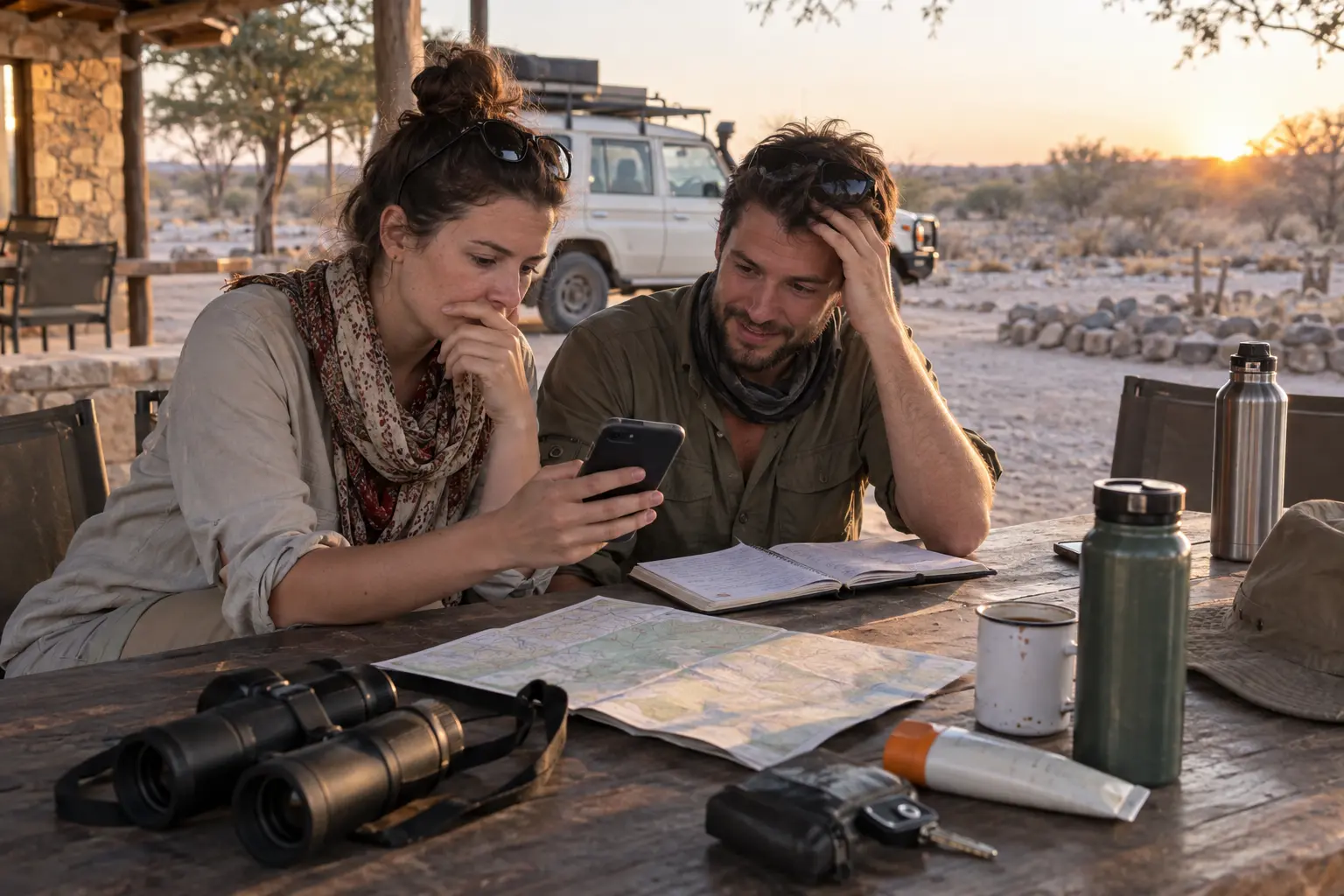
Ask for this information in writing. For registered businesses, the regulations provide that a description of activities, the rates and the conditions must be available in writing on request. A simple “scope, payment, cancellation” outline is enough to get the agreement written down without turning the exchange into an unreadable contract: what is included, what is not, the deposit and how it is paid, the cancellation deadline, and the rule if the weather turns or a site is closed.
What an Ayivoo profile tells you — and what it does not
On Ayivoo, the Tours & Experiences search lists provider profiles: businesses and individuals, rather than individual offers. A profile helps you identify someone to contact, see the area they cover and prepare your questions. It may also mark some fields as “to be confirmed with the provider”. If a profile shows no price, no active offer and no date, do not read anything into it about availability: ask. If it does not mention NTB registration, ask for the legal name and number, then check them in the directory. And if a very specific search returns nothing, widen it: that only means no profile matches those terms.
To draw up a first list, start with the Tours & Experiences providers associated with Etosha or those associated with Damaraland, then widen to the whole Tours & Experiences category if you are heading elsewhere. Keep two or three profiles whose area and type of outing match your plans, then compare their replies to the same message rather than their pages.
A ready-to-send message
Hello, we will be [number of people and profiles] at [place or accommodation] on [date]. Our main aim is [goal] and we need to take into account [pace, mobility, children or other need]. Could you tell us: the legal name and NTB registration number under which the outing is sold; who will guide us and in which language for the whole outing; who holds the first-aid certificate; the maximum group size; the pick-up point and time; whether a site guide or a concession is involved; what is included (entry fees, transport, water, meals); your rules on photos and encounters; the total price and the unit it applies to; and your payment, cancellation and change terms if the activity has to be modified?
This message is longer than most, but it saves several rounds of back-and-forth and makes the replies comparable. If one point is essential for you — accessibility, a child seat, a dietary requirement — turn it into a question that can be answered, not a wish. Send the same text to two or three providers, then compare how precise their replies are before you compare the amounts.
Five signs that it is time to slow down
- The person replying stays anonymous. An agency can perfectly well organise the outing, but you should know who delivers the service and under which registration.
- The promises are absolute. A serious guide separates what they control — preparation, route, briefing — from what they do not, such as a wildlife sighting or the weather.
- Access to a site or park stays vague. “We’ll sort it out on the spot” is not an answer when the site has its own guides or the activity requires a concession.
- Pressure replaces information. Limited availability may be real, but the scope and conditions should remain clear before you pay.
- Encounters are sold as a show. Visits “at any time”, photos promised with no mention of consent, or a community presented as a backdrop all call for an explanation.
Photos and reviews can strengthen or weaken that impression. Treat them as converging clues, never as proof on their own.
Frequently asked questions
Do I always need a private guide?
No. A small shared group can be sociable and kinder to your budget. A private guide makes sense when pace, language, photography, children or accessibility need a lot of adjustment. On routes where the site requires its own guide, that guide will be involved either way.
How can I check that a guide is authorised in Namibia?
Start with the business: its legal name and number in the Namibia Tourism Board directory. Then ask about the guide’s training and who holds the first-aid certificate. For an activity in a park or at a heritage site, ask separately which access right or concession applies. We found no public register of guides as individuals.
Can I visit Twyfelfontein or the White Lady with my own guide?
At Twyfelfontein, according to the NTB, some routes are self-guided and others can only be visited with a guide: ask which one is planned. For the White Lady in the Brandberg, a 2018 source described visits led by accredited guides; the current rule has not been verified. Ask your guide or the site to confirm who will interpret the visit and whether entry is included.
Can a guide based outside Etosha pick me up inside the park?
Not necessarily. According to New Era (3 August 2026), the Ministry of Environment was then defending a restriction on empty safari vehicles entering the park, which independent operators were contesting; whether it applies on the day of your visit is not known. Get written confirmation of the pick-up point, the gate used and the alternative if access is refused.
Is it reasonable to ask for references?
Yes, especially for a specialised activity or a group with particular needs. Respect former clients’ privacy, though, and back up references with questions about your own situation. A professional association logo is a clue, not a quality label.
What should I do if the guide I was promised is replaced?
Ask for the new person’s name, language and skills, then confirm that the programme and price are unchanged. If these points were decisive for you, go back to the cancellation or change terms you agreed.
What can I do if there is a problem with a registered business?
Start by writing to the provider, summarising what happened and the solution you expect. The 2004 regulations require registered businesses to display a notice stating that a written complaint can be sent to the chief executive officer of the Namibia Tourism Board if management does not resolve it.
Do I need to book a living museum visit in advance?
It depends on the place. The Ovahimba Living Museum states that advance booking is not possible and that payment is made in cash against a receipt. Check the conditions for each place before you set off, especially if you are relying on a bank card.
Sources and verification dates
- Business registration, supervision, first aid, vehicles, written rates, complaints: Government Gazette No. 3235 of 14 July 2004 (GN 136 to 139/2004), published by the NTB and the Legal Assistance Centre’s annotated version of GN 138/2004, read on 4 October 2026; the LAC’s Namlex “Tourism” index, 15 July 2026 update, with no amendment listed.
- NTB directory and forms: official directory and registration forms, consulted on 4 October 2026.
- Guiding qualification: Q0424 “National Guide” qualification, registered in 2014 with a review planned for 2019, and the review announced by the NTA in May 2021, consulted on 4 October 2026; current status not confirmed.
- Heritage sites: the NTB’s Twyfelfontein page, consulted on 4 October 2026; Travel News Namibia, article on the White Lady (spring 2018), a historical reference that does not establish the current rule.
- Parks and concessions: MEFT, concessions framework and notice of 1 December 2023; NWR’s Etosha page; New Era, article of 3 August 2026; NACSO on conservancy concessions. All consulted on 4 October 2026.
- Cultural visit: Ovahimba Living Museum FAQ (LCFN), consulted on 4 October 2026; applies to that place only.
Limitations: we have not checked any legal text published after 15 July 2026, nor how the NTB actually enforces the 2004 regulations, which apply to registered businesses rather than to each guide. The safety questions recommended here are precautions, not universal legal obligations. The Etosha situation is as reported on 3 August 2026. This article guarantees no authorisation, individual qualification, availability, wildlife sighting or quality of service. No provider was interviewed, and the illustrations do not depict any real guide, place or provider.
Where to start: write your one-sentence “successful outing”, pick two or three profiles in Ayivoo’s Tours & Experiences category, send each the same message, then look up in the NTB directory the business that gave you the most precise answer. The best guide is not the one who promises the most; it is the one who can tell you, for your date and your site, what they will do, with whom, and what they cannot guarantee.