
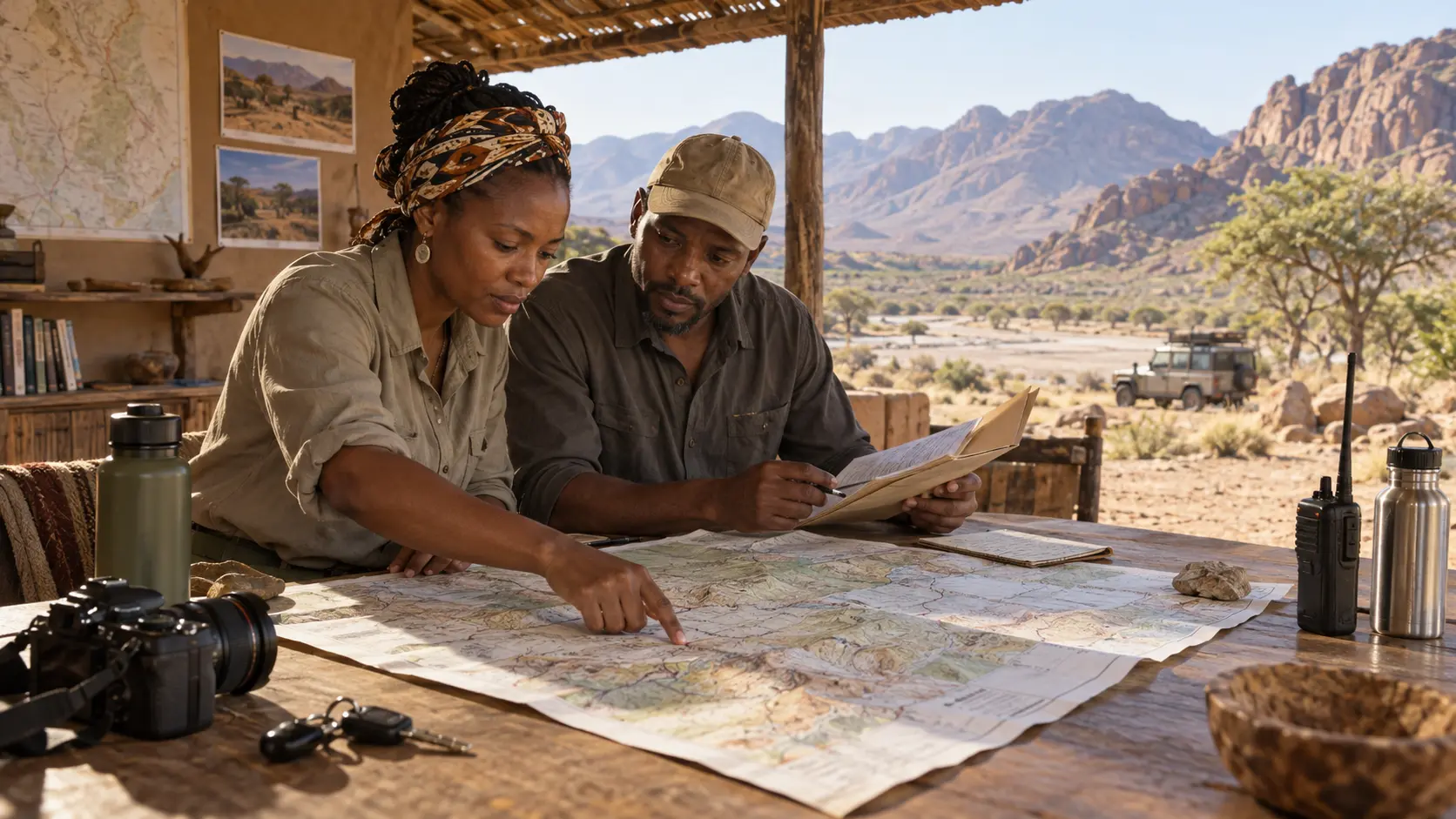
What to remember before booking local Damaraland experiences
- Book the route, not only the activity. In Damaraland, a guided drive, lodge stay, transfer or cultural visit only works if it fits the road day before and after.
- Local knowledge is part of the value. The best providers explain landscape, timing, wildlife ethics, heritage rules and road realities, not just a list of stops.
- Wildlife bookings need extra care. Desert-adapted elephant or rhino-related experiences should be handled through responsible providers who respect distance, rules and conservation sensitivity.
- Ask what is included before comparing prices. Vehicle, guide, fuel, site fees, meals, water, pickup, lodge access and cancellation terms can change the real cost.
- Use Ayivoo as a shortlist tool. Compare Damaraland providers on Ayivoo, then filter for local experiences, guided support, transport and accommodation fit.
Why local booking in Damaraland is different
Damaraland is not a destination where travellers should book isolated activities without thinking about geography. A rock-art visit, a wildlife drive, a lodge lunch, a transfer and a scenic detour may all sound simple online. On the ground, each one depends on distance, daylight, road condition, season, conservation rules and the next overnight stop.
That is why local booking in Damaraland should be treated as itinerary design. The traveller is not only buying a seat in a vehicle. They are buying timing judgement, route realism, context and a lower chance of wasting the best hours of the day. A strong provider will help travellers decide what to skip as well as what to include.
For travellers comparing Namibia with South Africa, Botswana or East Africa, this matters. Namibia often rewards self-drive independence, but Damaraland is where smart local support can turn remote-country uncertainty into a calm, memorable day.
What travellers may need to book
| Booking type | Best for | Question to ask first |
|---|---|---|
| Local guided drive | Wildlife, landscapes, dry riverbeds and orientation | What route is realistic from my base and season? |
| Rock-art or heritage visit | Twyfelfontein and cultural interpretation | Are guides, fees and current site rules included? |
| Lodge-based activity | Travellers who want less driving and easier logistics | Is the activity private, shared, fixed-time or weather-dependent? |
| Transfer or route support | Non-self-drivers or travellers connecting Etosha, coast and Damaraland | Does the provider understand luggage, timing and gravel-road buffers? |
| Specialist conservation experience | Repeat visitors or travellers focused on rhino, elephants or conservation context | What rules protect sensitive wildlife and local communities? |
Choose the base before choosing the activity
A common mistake is to choose a Damaraland activity because it looks interesting, then discover that the chosen lodge or route makes the timing awkward. Reverse the process. First decide where the traveller sleeps before and after the activity. Then check which providers can operate well from that base.
This is especially important around Twyfelfontein, Palmwag, Brandberg, Khorixas, remote conservancy areas and routes toward the Skeleton Coast. Names can look close on a map but still require long gravel-road time. Travellers should verify current route conditions and driving assumptions before paying.
Use Ayivoo's Damaraland search to build a local shortlist, then ask each provider which base and route they recommend for the traveller's dates. The best answer will be practical, not generic.
Trust signals that matter in Damaraland
Reviews are useful, but Damaraland needs more than a star rating. Look for signs that the provider understands remote logistics and responsible tourism.
- Route specificity: the provider can explain where the activity starts, where it ends and what changes if the day runs late.
- Wildlife ethics: the provider avoids promising close encounters and explains respectful distance.
- Heritage respect: the provider uses official or appropriate guiding for cultural sites and explains what visitors should not touch or disturb.
- Clear inclusions: fees, meals, water, pickup, guide and vehicle are described plainly.
- Delay plan: the provider explains what happens with late arrivals, bad roads, weather or vehicle issues.
- Local context: the provider can discuss community conservancies, conservation sensitivities and seasonal realities without overselling.
Questions to ask before paying
- Where exactly does the activity start and end?
- How long is the total time, and how much of it is driving?
- Which vehicle is used, and is it suitable for the current route?
- Are site fees, conservation fees, guide fees, meals and water included?
- What should travellers bring: cash, documents, sun protection, warm layers, camera gear or medication?
- Is the activity suitable for children, older travellers or nervous first-time safari guests?
- What happens if wildlife is not found or conditions change?
- What happens if the traveller arrives late from Etosha, Swakopmund or the Skeleton Coast?
- What is the cancellation or date-change policy?
- Which contact number works on the day of travel?
Save the answers offline. In remote parts of Namibia, the booking confirmation should be useful even when mobile signal is not.
Booking wildlife experiences ethically
Desert-adapted wildlife is one of the reasons travellers dream about Damaraland, but it should be approached carefully. Elephants, rhino and other animals move through a demanding landscape. Some species and locations are sensitive. Travellers should avoid providers who treat wildlife as a guaranteed performance or encourage close, disruptive behaviour.
For rhino-related context, conservation organisations such as Save the Rhino International describe Namibia as an important landscape for rhino conservation. Specific tracking, access and conservation claims should be verified through current provider information and official conservation partners before publication or travel.
A responsible wildlife provider will talk about patience, distance, quiet behaviour and conservation rules. That may sound less exciting than a guaranteed-sighting promise, but it is the stronger trust signal.
Booking Twyfelfontein and cultural sites
Twyfelfontein, also known as /Ui-//aes, is a UNESCO World Heritage site associated with rock engravings. Travellers should treat it as a heritage visit, not a casual roadside stop. Before booking, verify current opening conditions, guides, fees, site rules, photography expectations and accessibility.
Local interpretation matters here. Without a guide, travellers may see rock markings without understanding the cultural, historical or landscape context. With the right guide, the visit becomes slower, more respectful and more memorable.
When comparing local experiences on Ayivoo, ask whether the provider includes official site guiding or coordinates with the appropriate local guide arrangements.
Booking route and transport support
Not every traveller wants to self-drive every Damaraland section. A transfer or route-support provider can help link Etosha, Damaraland, Swakopmund and the Skeleton Coast. The booking should still be specific. Ask about gravel-road experience, luggage capacity, rest stops, fuel planning, pickup windows and what happens if the route changes.
Travellers hiring a vehicle independently should still use local providers for activity advice when needed. Self-drive and guided support are not opposites. A strong Namibia itinerary often combines independent driving with selected local experiences where interpretation or route judgement adds value.
How to compare prices without choosing badly
The cheapest local experience is not always poor, and the most expensive is not automatically best. Compare what the price actually includes:
- private or shared vehicle;
- qualified or local specialist guide;
- pickup and return location;
- site or conservation fees;
- meals, water and comfort stops;
- duration and route flexibility;
- cancellation and weather policy;
- community or conservation contribution where relevant.
If two providers quote very different prices, ask each one to break down inclusions. The clearer provider often makes the better planning partner.
Red flags in a Damaraland booking
- The provider promises specific wildlife sightings as if animals are scheduled.
- The route requires long gravel driving with no daylight buffer.
- Fees are unclear, especially site, conservation, park or guide costs.
- The provider cannot explain pickup, route, vehicle or return timing.
- The plan ignores children, older travellers, heat, dust or meal needs.
- The provider dismisses heritage rules, conservation sensitivity or wildlife distance.
- Communication becomes urgent only when payment is requested.
A practical booking flow
- Choose the route direction: Etosha to coast, coast to Etosha, Skeleton Coast link or slower Damaraland stay.
- Choose the base around the main activity, not only the room style.
- Shortlist providers on Ayivoo Damaraland search.
- Compare activities and experiences by route fit, not headline price.
- Ask the operational questions before paying.
- Save confirmations offline and keep the next day's drive realistic.
FAQ about booking local Damaraland experiences
Should travellers book Damaraland activities ahead?
For key activities, lodge-based experiences and specialist guiding, booking ahead is usually wiser. Availability, pickup logistics and route planning can affect the rest of the itinerary.
Is a local guide worth it?
Often, yes. A guide can add interpretation, route judgement, heritage context and wildlife ethics that travellers may miss on their own.
Should travellers choose the cheapest provider?
Not without comparing inclusions. A cheaper quote may exclude fees, meals, pickup, guide quality or route flexibility. Ask for the full operating detail.
Can travellers book on the same day?
Sometimes, but it is risky for a route-dependent region. Same-day booking can work for flexible travellers already near the activity, but first-time visitors should confirm earlier.
Sources to verify before publication
- UNESCO: Twyfelfontein or /Ui-//aes World Heritage listing for current heritage framing and site status.
- Save the Rhino International: Namibia for current rhino conservation context.
- Government of Canada Namibia travel advice, UK FCDO Namibia safety advice and U.S. State Department Namibia advisory for current road and traveller-safety guidance.
- Current Namibia tourism-board and local site information for Damaraland, Twyfelfontein, Brandberg, Palmwag and surrounding routes.
- Ayivoo live listings for Damaraland local experiences, guided tours, transfers and accommodation availability before publication.
Next step on Ayivoo
Open Damaraland providers on Ayivoo and shortlist by route fit first. The right local booking should make the day clearer: where you start, what you will actually do, what is included, how the provider protects the place and how you return without rushing.