
A provider profile is best read as a file with several layers: what the platform displays, what the provider claims, what you can check yourself, what other customers report and, finally, what ends up in your written agreement. The written agreement spells out what each side expects and makes offers easier to compare; it does not necessarily capture every commitment that was made. A thumbnail may be nothing more than a category image, a review may describe a very different job from yours, and a “verified” label points to a check whose scope you need to understand. The method comes down to three moves: sort each piece of information by layer, turn every grey area into a written question, then compare two or three providers on their answers rather than on their shop windows. Below you will find an evidence ladder, a way to sort photos, a reading of reviews that stops short of accusation, a comparison grid, a message to copy and what we observed on Ayivoo on 4 October 2026.
In short
- A profile mixes five kinds of information of unequal weight; get what will be delivered, at what price and on what date spelled out in writing.
- On Ayivoo, on 4 October 2026, some search-result thumbnails were generic category images: they do not show the provider. Open the gallery on the profile itself.
- The search offered a filter for verified profiles, but the page did not define the term. It guarantees neither quality, nor availability, nor outcome.
- A single image can be edited or AI-generated; ask for a current view, in context, of whatever matters to you.
- A useful review is dated, specific and detailed. A sign of possible manipulation justifies a question or a different choice, never a public accusation.
- EU, UK and US rules on fake reviews apply within their own jurisdictions; we found no Namibian rule specific to online reviews.
Five layers of information, five levels of evidence
The classic trap is not believing a lie. It is letting one piece of information do another’s job: a polished gallery ends up standing in for a quote, a high rating for a punctuality promise, a badge for a contract. Before you compare anything, sort what you see.
| Layer | Example | What it establishes | What it does not establish | How to firm it up |
|---|---|---|---|---|
| 1. Platform display | Category, town, “new on Ayivoo” label, thumbnail | The profile exists and is classified this way. | Quality, availability, or even that the thumbnail shows this provider. | Open the full profile and its gallery. |
| 2. Declared information | Description, listed amenities, languages, service area | What the provider states. | That it holds true for your date and your need. | Have the decisive point restated in writing. |
| 3. Documentary check | A number you found yourself in an official directory, the same legal name on the quote | The identity of the business. | The competence of the person who turns up. | Search yourself, not from a screenshot someone sent you. |
| 4. Reviews | Accounts from past customers, on Ayivoo or elsewhere | Other people’s past experiences. | Your future experience; the authenticity of each review. | Spot repeated details and turn them into questions. |
| 5. Written commitment | Quote, confirmation, terms | What the provider undertakes to supply. | Anything missing from it still needs proof from elsewhere: have it added. | Reread before any payment and ask for missing points to be added. |
A hypothetical example, purely for illustration: an accommodation listing advertises a pool “available on site”. That is declared information, useful for sorting. If the pool is what decides your choice — children, November heat — it has to climb the ladder: first a question (“will it be open from the 12th to the 15th?”), then a line in the confirmation. A pool closed for maintenance has a peculiar talent for never appearing in the photos.
What we observed on Ayivoo on 4 October 2026
What follows describes the public pages we consulted on 4 October 2026: French-language search pages and two provider profiles that were displayed in English. Labels from the search pages are translated here, so the English interface may word them differently. The interface can also change: whenever you meet a label, rating or section not described here, ask the same question — who produced it, on what basis, and as of when?
- Result cards showed the name, category, town and region, sometimes a short description and, on many profiles, a “new on Ayivoo” label. On the cards and on the profiles we opened, no rating and no review count appeared.
- Thumbnails were not all photos of the provider: several cards in the same category shared one identical generic image, while others showed a photo specific to the profile.
- The profile could contain a gallery, sometimes captioned by the provider; amenities marked “Available on site”; fields flagged “To be confirmed with the provider”; a note when opening hours had not been supplied; an offers section stating “No active offers”; and buttons to reveal a phone number, email address or official website.
- The filters included verified profiles and profiles with photos, plus a “verified first” sort order (on the French interface: « Profils vérifiés », « Avec photos » and « Vérifiés d’abord »). The search page did not define “verified”, and the first cards sorted this way carried no visible “verified” label.
Ayivoo’s Trust & Safety page is the most precise source we found. It states that providers may be required to complete verification that can include government-issued ID, business registration documents, proof of address, tax identification and, where applicable, insurance documentation, and that Ayivoo may approve, reject or suspend a provider. It mentions action against fake reviews and the reporting of inaccurate listings, without specifying, on the page we read, the channel or the procedure. The Terms of Use state that Ayivoo is not responsible for the quality of providers’ services and does not guarantee their execution.
An honest reading: a verification label may reflect an identity or business check on the platform side. It does not tell you which documents were examined for this particular profile, nor whether the provider is competent, insured for your activity or free on your date. The FAQ for the Tours & Experiences category explains that bookable offers are paid online and that the others are confirmed with the operator: a profile without an active offer opens a conversation, not a booking.
To build your shortlist, start from tours and experiences providers, accommodation providers or home and property service providers, tick the photos filter if images matter to you, and keep three profiles at most.
Mood shot or proof of work: sorting the photos
A photo answers one question at a time; the trouble starts when you ask it a different one. Before you grow attached to an image, work out which family it belongs to.
| Type of image | How to recognise it | What it can support | The question to ask |
|---|---|---|---|
| Category or generic image | The same image recurs across several profiles. | Nothing about this provider. | “Do you have photos of your own service?” |
| Stock, brand or destination image | Advertising-style framing, a famous landscape, new equipment with no context. | A mood, a type of product. | “Does this image show your premises or your equipment?” |
| Photo of the premises or equipment | Details consistent from one image to the next, precise captions. | A clue that a place or object exists, if the image is recent, consistent and unedited. | “When was it taken, and is this the one I will get?” |
| Photo of completed work | Before and after, a buffet served, décor set up, a vehicle in service. | Skill already exercised, in one specific case. | “Do you have an example comparable to my request?” |
| Edited or AI-generated image | Sometimes: overly smooth textures, inconsistent details, impossible light. Their absence proves nothing. | An intention, not a reality. | “Do you have an unedited photo of this item?” |
Three tests that take less than five minutes
- Repetition. If the same image appears on other profiles in the search, it proves nothing for this one.
- Reverse image search. In Chrome, right-clicking an image offers a Google Lens search; on google.com, image search also accepts an uploaded file or an image address. Finding the photo elsewhere does not prove deception: a lodge publishes its pictures on several sites, a tourism office illustrates a place with an establishment’s photo. The only useful question is whether it shows this provider and this service.
- Consistency. A profile that advertises a twelve-seat minibus but only shows a pick-up, or a “family” room with a single double bed, calls for clarification, not a verdict.
Asking for a current photo without asking for the impossible
Name the decisive item and say why it matters: the boot with two large suitcases in it for a transfer, the entrance step for a wheelchair, the table laid for forty guests, a repair comparable to yours. A tape measure in the frame says more than any wide-angle lens.
Keep the request proportionate: no customers’ faces, no number plates, no identity documents, no interiors of private homes. A provider who declines to show a job because the client has not agreed, and offers another example instead, is behaving professionally. A persistent absence of any image specific to the service, when the profile promises some, does however belong in your comparison.

Reading reviews: useful, weak or best set aside
A useful review reads like a short situation report: when, for which service, in what context, with at least one checkable detail — the time the driver arrived, the size of the group, how an unexpected problem was handled. It needs to be neither long nor positive.
- Useful: dated, tied to the same service as yours, with a similar context (family, group, season, distance).
- Weak: general praise, an old review of a service that may have changed, an account of a different job.
- Best set aside: a review about another place, or one that says nothing about the service.
Read the provider’s replies too: acknowledging a fact, explaining what has changed and protecting the customer’s privacy is often worth more than a run of five stars. A negative review condemns no one; ask yourself whether it touches the core of your need. Ten minutes’ delay matters little on a city tour and a great deal on a transfer to catch a flight.
Possible signs of manipulation: questions, not proof
Some patterns are a reason to slow down: a burst of very similar reviews in the same week, near-identical wording, a perfect score from a large number of reviews on a recent profile, reviews unrelated to the service. None of them proves fraud on its own: a provider who asks customers from the same season for feedback will naturally get similar texts.
You cannot know an author’s real identity, nor whether they were offered an incentive. So do not publicly accuse a provider of fake reviews: it could be unfair and, depending on the country, legally risky. Ask the question, give more weight to layers 3 and 5, pick another profile if the doubt persists, and report a profile you believe is inaccurate to the platform that displays it.
Who bans what, and where
Several regulators have defined what counts as a manipulated review. Their texts help you frame questions; they do not become obligations for a Namibian provider serving you in Namibia.
| Jurisdiction | Text | What it says about reviews | Scope |
|---|---|---|---|
| European Union | Directive (EU) 2019/2161, amending Directive 2005/29/EC | A trader who gives access to reviews must state whether and how it ensures they come from real customers; presenting reviews as genuine without reasonable steps, submitting fake reviews or distorting them is prohibited. | Traders subject to the law of EU Member States. |
| United Kingdom | DMCC Act 2024, Schedule 20, para. 13; CMA guidance CMA208 of 4 April 2025 | Bans fake reviews, incentivised reviews whose incentive is concealed, and misleading publication; requires anyone publishing reviews to take reasonable and proportionate steps to prevent and remove them. | Practices subject to UK law. |
| United States | FTC rule on consumer reviews and testimonials (16 CFR Part 465), announced 14 August 2024 | Targets fake reviews, including AI-generated ones, incentives conditioned on a positive or negative review, undisclosed insider reviews and intimidation aimed at negative reviews. | Businesses within the FTC’s remit. |
| Namibia | No rule specific to online reviews found | The consumer protection chapter of the Electronic Transactions Act 4 of 2019 does not appear to be in force in the annotated version we consulted; in September 2026, Cabinet directed that a Consumer Protection Bill be drafted. | Check again: a text may be adopted after our research. |
What you can check yourself
The documentary layer is the most neglected, even though it often takes a single search. For a tourism business — accommodation, booking agency, tour operator, camp — the public directory of the Namibia Tourism Board (NTB) lets you search by name, region, town or registration number. Ask for the legal name and number under which the service is sold, then look them up yourself. A search that comes up empty calls for a question, not suspicion: the business may be registered under a name other than its brand.
For an everyday service — repairs, cleaning, catering, removals — we did not identify a single public directory covering these trades. Checking then comes down to consistency: does the name on the quote match the one on the profile? Are the contact details shown the ones that actually answer you? Is the payee the business, or the person you have been dealing with? A mismatch may have a simple explanation, but that explanation should come before the bank transfer. To structure these exchanges, see how to write a useful home-repair service request or compare catering quotes beyond price. There is no need, on the other hand, to demand a copy of an ID document for a city tour: it is healthy for a provider to refuse to send one to a stranger.
Comparing three profiles on a single page
Copy this grid into a note and fill it in as the answers arrive: E for what you have established yourself, C for what is only claimed, ? for what you still need to ask.
| Point of comparison | Profile 1 | Profile 2 | Profile 3 |
|---|---|---|---|
| Consistent identity (name, contact, area, activity) | |||
| Photos specific to the provider, not generic | |||
| Example of work comparable to your request | |||
| Dated reviews relevant to your service | |||
| Registration or legal name checked by you | |||
| Precise written answer to your questions | |||
| Total price, unit and conditions in writing |

A purely illustrative example: a profile with no reviews at all, whose business appears in the NTB directory and which answers point by point, can come out ahead of a profile full of generic images and evasive replies. The grid does not decide for you; it stops one attractive photo from counting three times.
The message to copy
This message turns what you saw on the profile into questions that can be checked. Adapt the brackets and delete anything that does not apply.
Hello, your Ayivoo profile matches what we need: [service] in [place] on [date], for [number of people or scale of the job]. Before we decide, could you tell us: the legal name of the business and, if applicable, its registration number; who will actually carry out the service; whether the photo [describe the image] shows your own [vehicle, premises, work] and when it was taken; a current photo of [decisive item], ideally with something that shows scale; an example of comparable work, if your clients have agreed to it being shared; what the total price includes and the unit it is based on; and your payment, change and cancellation terms? Several reviews mention [specific point]: is that still the case? Thank you — we are comparing two or three proposals and will reply quickly.
The reply becomes part of your file. A provider who deals with every point, says frankly “I can’t show that job, but here is a similar one”, or corrects your interpretation tells you more than a rating ever will. A reply that skips everything to talk about the deposit also tells you something, just in the other direction. Send the same text to every profile on your shortlist, then compare the answers before you compare the prices.
What should be in writing before you pay
Everything that weighed on your choice should end up in layer 5. A room photo won you over: get the room type written down. A review praised an English-speaking guide: get the guiding language written down. The profile advertised twelve seats: get the capacity and the luggage allowance written down.
- Who: the business, and the person carrying out the work, or at least their role.
- What: the scope, what is included and excluded, the items seen in photos that matter to you.
- When and where: date, time, meeting point or work location.
- How much: total price, unit, deposit, balance and payee.
- What if: changes, delays, weather, cancellation by either side.
When a profile has no bookable offer on Ayivoo, this agreement is put together directly with the provider: keep a written record of it. For a journey between two towns, the method to prepare an intercity transport booking in Namibia complements this list; in the capital, the Windhoek local booking guide for travellers shows how to line up several providers one after another.
Frequently asked questions
What does the verified-profiles filter on Ayivoo mean?
As of 4 October 2026, the search page did not define it. Ayivoo’s Trust & Safety policy states that providers may be required to provide documents such as government-issued ID or business registration. The filter guarantees neither quality, nor availability, nor outcome: get whatever matters to you in writing.
Is a profile without a rating or reviews less reliable?
Not in itself. On the search cards and the two profiles we consulted on 4 October 2026, no rating or review was displayed. Make up for the missing history with a documentary check, a comparable example of work and a precise written agreement.
How can I tell whether a photo really shows the provider?
Check that it does not recur on other profiles, run a reverse image search with Google Lens, then ask for a current photo of the decisive item. Finding the image elsewhere does not prove deception.
Can I rely on reviews published on other sites?
Yes, if they concern the same business, the same service and a recent period. Each site applies its own moderation rules, and two businesses with similar names are easily confused: check the town and the exact name.
I have doubts about some reviews: should I say so publicly?
No. A clue is not proof, and a public accusation can be unfair and, depending on the country, legally risky. Question the provider, choose another profile, or report an inaccurate profile to the platform that displays it.
Do EU or UK rules on fake reviews protect a booking in Namibia?
Not automatically: Directive (EU) 2019/2161 covers traders subject to the law of EU Member States, and the UK rules cover practices subject to UK law. We found no Namibian rule specific to online reviews. Rely first on the written agreement.
A provider refuses to send a current photo: what should I conclude?
It depends on the reason. Refusing to show a client’s home is normal, especially if another example is offered. Refusing any image specific to the service when the profile promises some is a point of comparison, not proof of fraud.
Sources and last check
- Ayivoo display: public search pages (Tours & Experiences, Accommodation, Home & Property, “verified first” sort), two provider profiles, the Trust & Safety policy and the Terms of Use, consulted on 4 October 2026; a limited sample that does not describe every profile.
- European Union: Directive (EU) 2019/2161 (French-language version; EUR-Lex offers every EU language), Article 7(6) and Annex I, points 23b and 23c of Directive 2005/29/EC as amended.
- United Kingdom: CMA208, Fake reviews guidance, 4 April 2025.
- United States: FTC press release of 14 August 2024.
- Namibia: Electronic Transactions Act 4 of 2019, annotated version by the Legal Assistance Centre; New Era, Cabinet Briefs of 23 September 2026; Namibia Tourism Board directory.
- Reverse image search: Google Help.
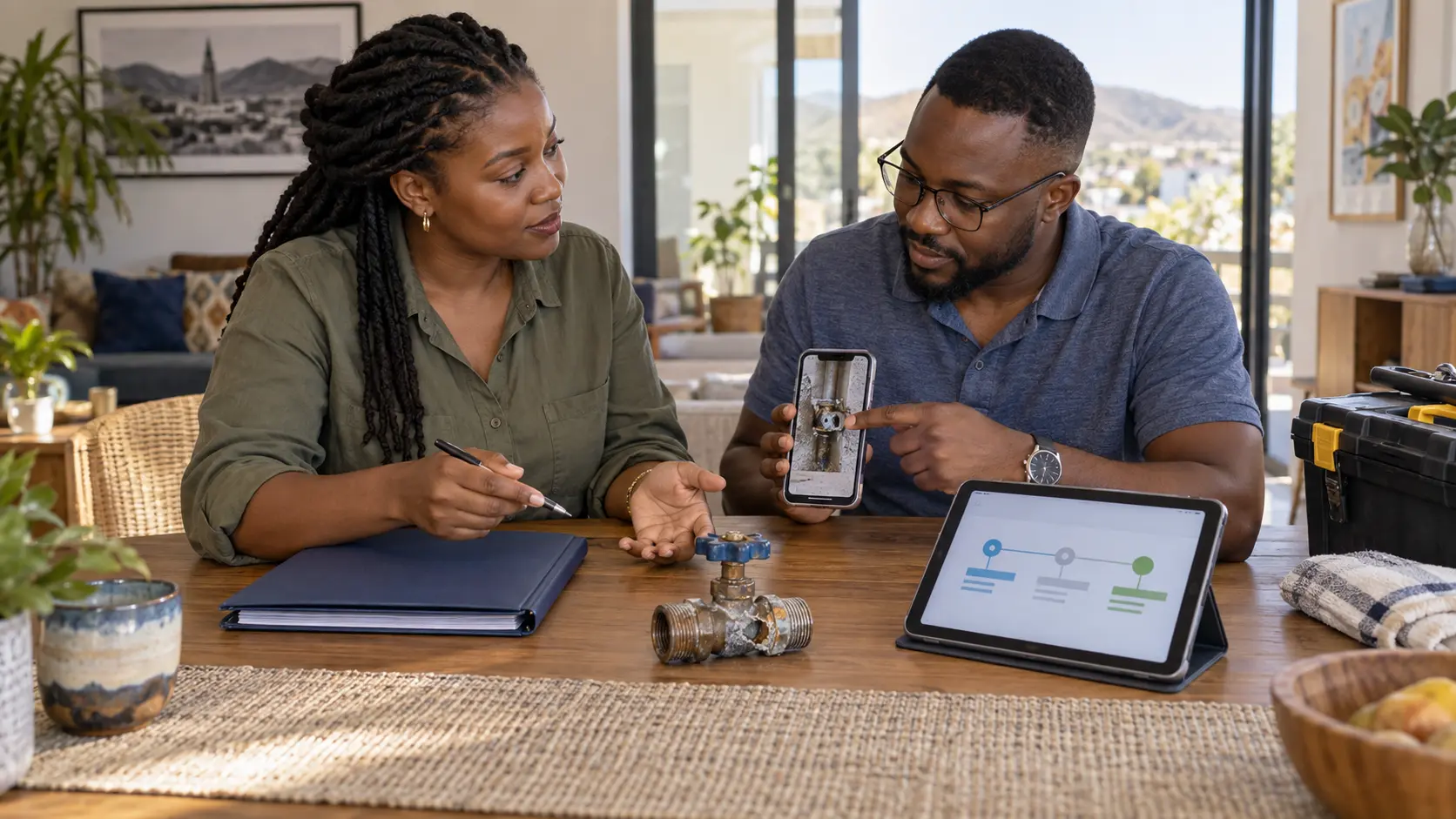
Sources consulted on 4 October 2026. Limitations: no provider was interviewed, and no profile is rated or recommended. This guide is not legal advice. The illustrations do not show an Ayivoo provider or a real place. The Ayivoo interface, the status of Namibian legislation and other platforms’ rules may have changed since then.
What we would do in your place: pick three profiles in the Ayivoo search or in the category that fits your need, fill the grid with C and ?, send the same message to all three, then turn each ? into an E or into a line of the written agreement. To weigh what a local provider’s proximity genuinely brings, and what it does not guarantee, read Discovering Namibia through local knowledge.