
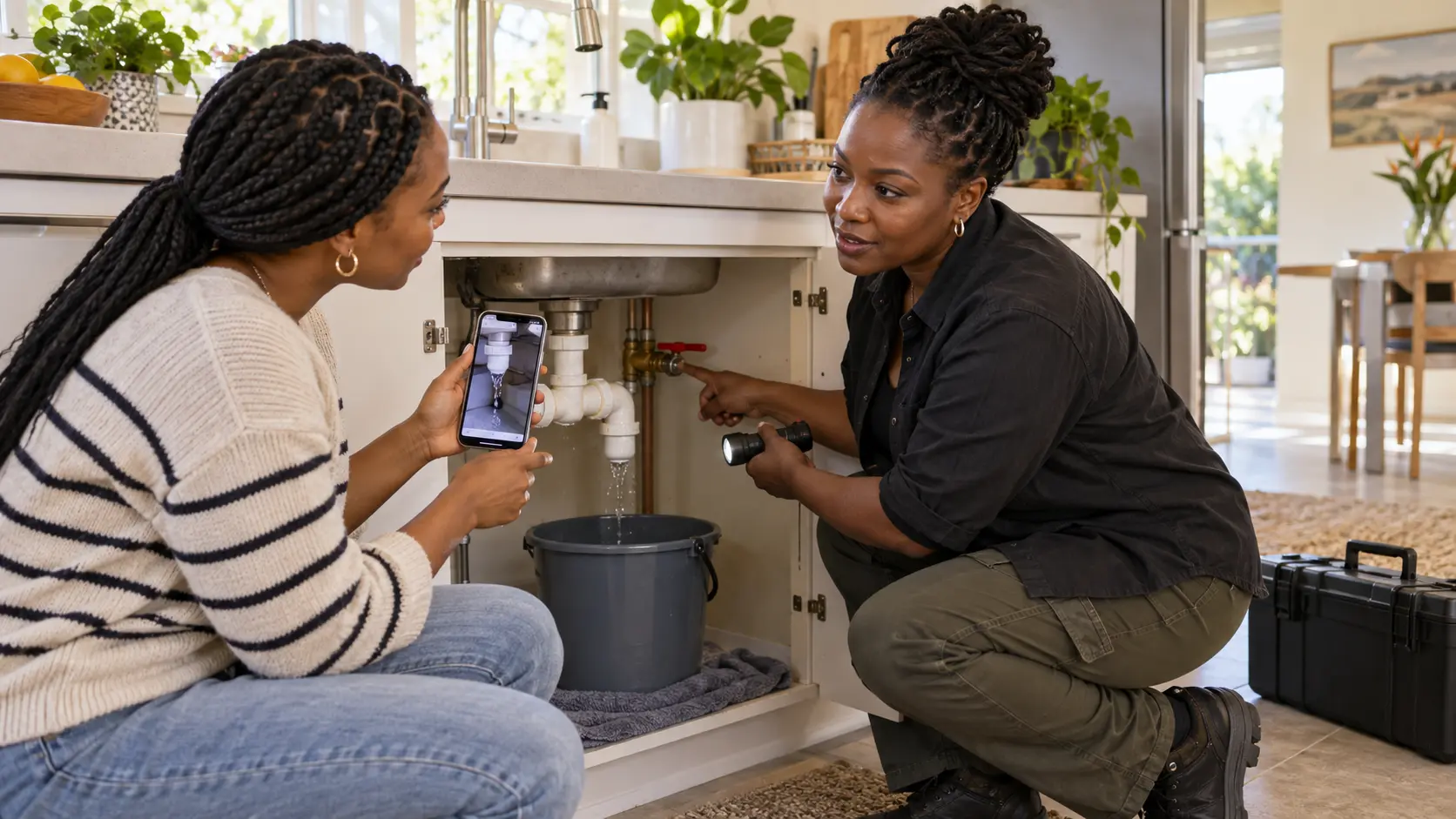
A useful repair request does not try to diagnose the fault for the professional. It shows the symptom, where it is, when it happens, what you have already tried and how to get into the property. With that in hand, a provider can tell whether the job is within their trade, plan the trip and keep call-out, diagnosis, labour and parts apart.
In Namibia, two questions come before the message: is there a danger that means you should stop and call the emergency or relevant service, and is the fault inside your home or on the municipal network? Only then send the same request, with three photos that give away nothing private, to two or three providers, and compare their answers line by line using the grid further down.
The short version
- Danger first: smoke, a burning smell, sparks, a suspected gas leak, water near electrics or a structure that looks unstable — stop using it, move people away and call the emergency or relevant service. Don’t take anything apart.
- Network or home: if the neighbours are affected too, or the leak is on the street side, contact the municipality or your area’s electricity distributor first.
- Describe what you observe, without stating a cause you are not sure of.
- Three images: one wide shot, one close-up and a readable reference if there is one — no faces, documents, account numbers or GPS location.
- Give the area, not the address: town, suburb, access; the full address goes only to the provider you choose.
- Compare two quotes covering the same work: call-out, diagnosis, parts, labour, VAT, deposit, extras and a tested result.
- An Ayivoo profile shows that a provider is listed in the directory — not that they are qualified, insured or available.
Before you write: emergency, urgent job or routine request?
A dripping tap can wait three days; a flooded room next to a multi-plug cannot. This first sort changes the tone of your message, how many providers you contact and how much you are prepared to pay for speed.
| What you notice | Level | What to do |
|---|---|---|
| Smoke, a burning smell, sparks, a hot socket or distribution board, a smell of gas, water that may be touching electrics, a ceiling or wall that is bulging | Stop now | Stop using the equipment, move people away, call the emergency or relevant service. Don’t handle anything you cannot handle safely. |
| A leak that is getting worse, water spreading, no power anywhere in the home, an outside door that no longer closes | Urgent job | Limit the damage without taking risks: a container under the leak; move belongings only if no socket or appliance is wet. Then ask first for a time slot and the cost of an urgent call-out, not for a long quote. |
| A broken appliance, a slow drip, a single dead socket, a cracked tile, a cupboard door | Routine request | Take your time: a complete message, two or three replies, a comparison. |
Smoke, a burning smell, sparks, a major leak, a suspected gas leak, an unstable structure or any risk of water meeting electricity mean making the area safe first and calling the relevant services. In Windhoek, the City’s emergency page, checked on 4 October 2026, lists the main fire station (061 211 111) and City Police (061 302 302, toll-free). Elsewhere, write down the numbers published by your municipality or regional council now, before you need them.
This guide offers no emergency diagnosis and no universal technical procedure. When safety is at stake, an exchange of messages on a platform does not replace a qualified professional or the appropriate emergency services.
Your home or the network?
Paying a call-out fee to discover that the whole suburb is without power is an avoidable expense. Before messaging an electrician, check whether the neighbours still have lights. If your home runs on a prepaid meter, check the credit on display too. For water, ask yourself whether the leak is in the street, at the meter or clearly inside the property.
- Several homes affected, or a leak on the street side or at the meter: contact the public service first. In Windhoek, the City’s website, checked on 4 October 2026, gives +264 81 950 3777 and enquiry@windhoekcc.org.na; earlier official City messages (August 2025) gave 061 290 3777. If you cannot get through, use the number printed on your bill or the City’s official channels. Outside Windhoek, electricity may be supplied by a regional company or by the municipality: your bill or lease usually tells you whom to contact.
- Only your home, or a single appliance, is affected: that is a job for a private provider — and the subject of this guide.
Where exactly does municipal responsibility for a water pipe end? We found no Namibian public rule clear enough to summarise. Ask the municipal service when the leak is close to the meter.
Write down the symptom, not your conclusion
“There is water under the sink when the tap is running” is more useful than “the pipe is broken”. “The socket stopped working yesterday; the other sockets in the room still work” is more precise than “the socket needs replacing”. Your guess may be right, but it can also steer the quote towards a part nobody needed.
Name the room and the exact spot, say how long the problem has been there, whether it is constant or comes and goes, what sets it off, any noises, smells or warning lights, and what changed recently: a power cut, a storm, building work next door, a new appliance plugged in. Mention anything you have already tried. Do not open an appliance, a distribution board or a gas installation to get better photos.
The three-photo evidence plan
In this order, from widest to closest:
- Context: a shot wide enough to locate the equipment and show how to reach it.
- Symptom: a close-up of the leak, crack, broken part or error message, taken without putting yourself at risk.
- Reference: the rating plate or model number, only if you can see it without taking anything apart.
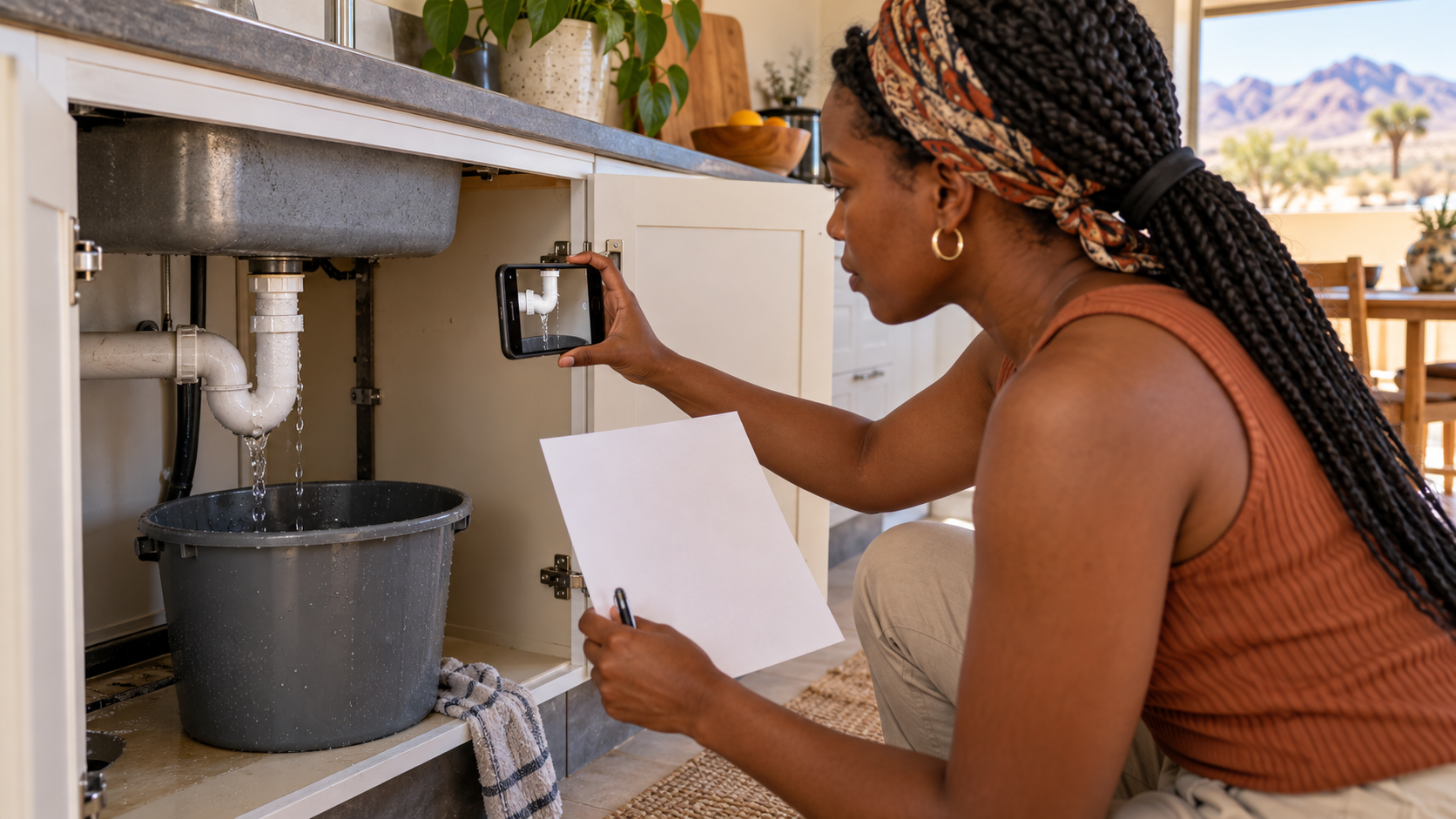
Add a short video only if movement or sound matters. Keep papers, faces, keys, codes, screens and irrelevant personal items out of the frame. A photo is not permission to enter the home, nor to reuse the picture.
Before you hit send, three habits protect your privacy:
- The location stored in the file: many phones record where a photo was taken. Switch that setting off, or send a screenshot of the picture instead of the original.
- Numbers only your utility needs: meter, customer-account or prepaid-token numbers are none of a repairer’s business in a first message.
- Whatever gives the property away: a gate with a street number, the view from the window, a visible alarm system. Crop them out.
Place the job without handing over your address
In Namibia, distance shows up in the price very quickly. On Ayivoo, profiles in the home and property services category show a town and a region: a provider based in Karibib or Ongwediva is not necessarily the one who will reach Windhoek fastest, and the reverse is just as true. Give enough for them to estimate the trip: town, suburb or area, a well-known landmark, and whether the last kilometres are tar or gravel if it is a farm or a lodge.
Say what kind of home it is, which floor, whether there is a lift, parking, a security guard or a gate. Give the full address only to the provider you choose. Say who will be there and which time slots are realistic. If you rent, check your lease for who must authorise and pay for the work, and get written approval from the landlord, the letting agent or the body corporate before ordering a non-urgent job. At a lodge, guesthouse or holiday rental, tell the host or manager first: they may have their own repairer, and they need to know who is coming in.
Flag anything that changes the visit: a pet to shut away, furniture to move, outside access, a water or power shut-off to coordinate. The provider also needs to know who supplies the materials and whether someone else — an owner or a manager — has to approve the work.
The message, ready to send

Hello, I’m looking for a professional to deal with [type of problem] in [town, suburb]. Since [when], I’ve noticed [precise symptom]. It happens [how often / what triggers it]. So far I have [what you tried, or “not taken anything apart”]. The problem affects [only my home / the neighbours too / not checked]. I’m attaching three photos: context, close-up and reference.
Access: [type of home, floor, parking, gate, any gravel road]. I’m available [time slots]. [I’m renting; the landlord’s approval is confirmed / pending.]
Could you tell me: 1) whether you handle this kind of problem and which area you cover; 2) what the call-out and the diagnosis cost, and whether they are charged if no repair is done; 3) how you charge for labour and parts, and whether VAT is included; 4) whether you ask for a deposit, and when; 5) your next available slot; 6) how any additional work will be approved before it starts?
If it is urgent, swap the long quote for a question about timing and making things safe, without playing down the risk: “Can you come today to stop [the leak / the problem]? What does an urgent call-out cost?” The full quote can come afterwards.
Know what the first price covers
Ask whether the call-out and the diagnosis are charged even if nothing gets repaired. Have labour, parts, consumables and any return visit listed separately. If the problem can only be priced after an inspection, set a ceiling for the diagnosis and insist on giving your approval before any further spending.
For a part, ask for its reference, its price, any warranty and whether the old part will be handed back, if that is relevant and agreed. Have the expected result written down: “leak stopped and tested” is easier to check than “plumbing repaired”. Before confirming, reread the scope, the payment terms and the cancellation conditions yourself.
Two points specific to Namibia. The standard VAT rate is 15%, but a small provider may not be registered for VAT: ask whether the amount is “VAT inclusive”, “excluding VAT” or “no VAT charged”. And if a deposit is requested to order a part, have its amount written down, what it covers and whether it is refundable if the part never arrives.
A grid for comparing two quotes
Two replies can only be compared if they cover the same job. Copy this grid into a note, fill in one column per provider and leave blank whatever wasn’t said: every empty cell becomes a question.
| Line | Quote A | Quote B | Question if the cell is empty |
|---|---|---|---|
| Call-out | How much, from which town, charged even without a repair? | ||
| Diagnosis | How much, deducted if I give you the job? | ||
| Labour | Fixed price or hourly? Estimated time? | ||
| Parts | Reference, new or second-hand, supplied by whom? | ||
| Consumables, return visit | Included? Is a second visit charged? | ||
| VAT | Included, added on top or not applicable? | ||
| Deposit | How much, when, refundable? | ||
| Extras | Evening, weekend, emergency, distance: which ones, how much? | ||
| Approval before exceeding the quote | How will you warn me before exceeding the amount? | ||
| Tested result | Which test shows that it is fixed? | ||
| Written warranty | On what, for how long? (none is assumed) | ||
| Paperwork | Invoice, checks or documents the professional considers applicable, proof of insurance if that matters to you | ||
| Payment | Cash, transfer, other? Receipt provided? |
The cheapest quote is not necessarily the best value: a low figure that leaves out the call-out and the parts can end up above a complete quote. The same comparison logic, applied to a very different field, runs through our guide on how to compare catering quotes beyond price.
Listed, qualified, insured, available: four different questions
A single profile or a single reply can seem to say it all. Separate what is established from what you still need to ask:
- Listed in the directory: the profile exists on Ayivoo, with a town and a region. That is all the existence of a profile establishes.
- Qualified for your problem: something to ask, case by case. Only one rule was checked here: in Windhoek, the City only processes applications for a connection to the electricity network if they are submitted by an electrician approved by the City. It concerns connections, not every repair. For your job, ask the professional which documents or checks apply, and why; we assume no general obligation.
- Insured: cannot be inferred from anything. If it matters to you — a rented home, major work, work at height — ask for proof.
- Available: only a reply from the provider, for a given date, establishes it.
Three scenarios to find your bearings
These cases were built to illustrate the method; they are not testimonials.
A leak under the sink in a rented flat in Windhoek
Water only runs while the tap is open, and a container is enough to catch it. This is a routine request, not an emergency. Tell the landlord or agent in writing first, with the three photos. If choosing the provider is up to you, send the message to two plumbers, fill in the grid and have “leak stopped and tested with the tap open” written down.
An air conditioner that no longer cools, far from the nearest provider
The unit runs but blows lukewarm air. Photograph the rating plate if you can see it without dismantling anything, and note how long the fault has been there. The provider you found is based in another town, so the call-out line of the grid matters as much as the repair. Ask whether they group visits to your area on certain days, and whether a first assessment from the photos is possible before they travel.
A socket that gets hot and smells of burning
This is not a request to compare. Stop using the socket, don’t take it apart, keep people away. If there is smoke or flame, call the emergency services. Once the danger has passed, look for an electrician urgently and ask which checks or documents they will give you after the work.
Protect access to your home
Confirm the name of the person coming, the time slot and the contact channel. Never send a permanent alarm code or the location of a hidden key in a message. If you cannot be there, clearly appoint someone else and define what they are allowed to approve. When the provider arrives, check that the work matches the appointment. For broader habits in the city, see also our safety and logistics guide to Windhoek.
After the work, ask what was done, keep the references and test the agreed result. If something changes along the way, or the result falls short, start with the facts and their effect, propose a practical solution and a reply deadline, and confirm any new agreement in writing.
Searching Ayivoo with a method that won’t go out of date
Ayivoo files plumbing, electrical work, air conditioning, locksmiths and small handyman jobs among its Everyday Services, in the home and property services category. Here is the method, rather than a number that would be wrong next week:
- Open the provider search for home and property services.
- Narrow it down with a keyword. The profiles we looked at were written in English, so try the trade name — for example plumbing — or a town, for example Windhoek. Keyword search is approximate: read each profile.
- Keep two or three profiles whose town and description match your need, and send them the same message.
Many profiles are directory listings with prices on request, no published price and no reviews: the profiles themselves invite you to confirm scope, service area, availability and the quote. A search with no results only means that no profile matches those terms — not that there is no professional in your town. For the wider logic of booking locally, our local booking guide to Windhoek complements this method.
To build your shortlist: open the home and property services category, keep two relevant profiles rather than ten, and note the town of each one: you will need it for the call-out line of the grid.
Frequently asked questions
Should I ask for a quote before any visit?
Ask what can be priced remotely and what the diagnosis costs. Some problems can only be quoted reliably after an inspection; in that case, agree on a ceiling before any work starts.
Which photos actually help?
A context shot, a close-up of the symptom and a reference you can reach. Don’t dismantle anything, hide personal information unrelated to the repair and remove the GPS location from the file.
No power at home: electrician or utility?
If the neighbours have no power either, contact the municipality or your area’s distributor first. With a prepaid meter, check the credit. If only your home is affected and there is no sign of danger, an electrician is the right person to contact.
I’m a tenant: can I call a repairer myself?
That depends on your lease. For non-urgent work, get the landlord’s or managing agent’s written approval of the job and of who pays. If there is a danger, make the place safe first and tell them straight away.
Does the quoted price include VAT?
Not necessarily. Namibia’s standard rate is 15%, but a small provider may not be registered for VAT. Have “VAT inclusive”, “excluding VAT” or “no VAT charged” written down.
Can I let the provider in while I’m away?
Only with a clearly agreed arrangement you trust: the worker’s identity, the person standing in for you, limited access and a defined authority to approve work. Avoid sharing permanent codes.
Does Ayivoo check the repairer’s qualifications?
Don’t infer a qualification or an insurance policy from the mere existence of a profile. Ask the professional which documents apply to the planned work.
Sources and last check
Pages checked on 4 October 2026. Fire brigade, City Police and general contact in Windhoek: City of Windhoek — Emergency Contact Numbers (undated page, valid for Windhoek only). The number 061 290 3777 appears in a message from the City’s official X account in August 2025. Electricity connection through an approved electrician, Windhoek only: City of Windhoek — Apply for an Electricity Connection. Standard VAT rate of 15%: Value-Added Tax Act 10 of 2000, 2024 annotated version published by NamRA, located through its index without a full reading of the PDF; the rate also appears in its VAT brochure. Search and profiles: public Ayivoo pages, checked on the French version of the site.
Limits: this guide helps you word a request; it diagnoses no fault and replaces neither a qualified professional nor the emergency services. It gives no prices, because no comparable public prices were found, and it settles neither how costs are split between landlord and tenant nor the licensing or certification obligations of electricians, plumbers and other trades. No professional was interviewed for this version. The images are illustrations: they show no real job, place or provider. Numbers and rules can change, and nothing guarantees that a number answers at all hours: check them with your municipality.
When the replies come in: enter them in the grid, ask one question per empty cell and confirm only once you have written agreement on the scope, the deposit and any extras.