
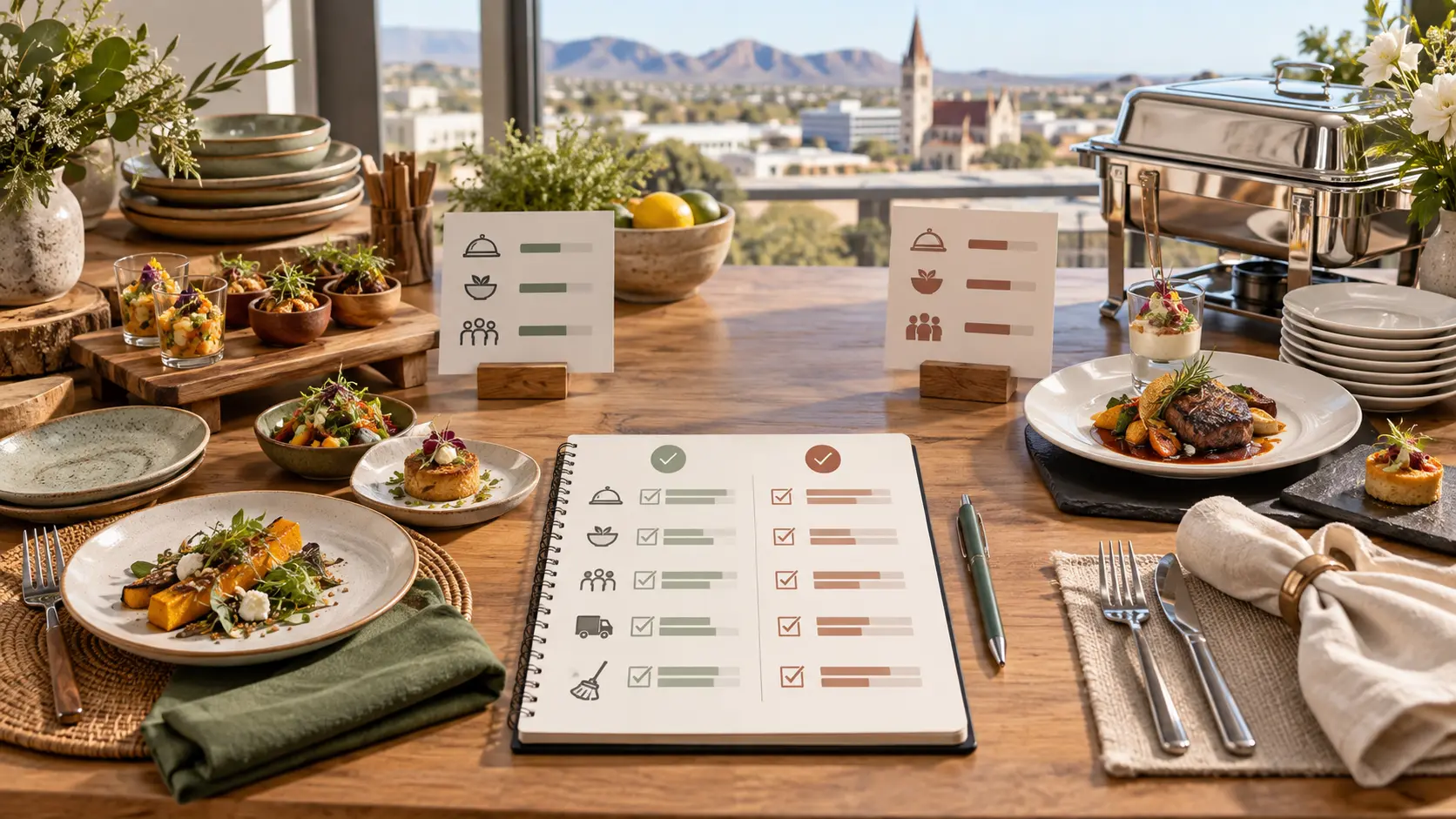
The cheapest catering quote is only comparable with the others if it covers the same number of portions, the same service, the same equipment and the same clean-up. Bring every proposal back to a common scope, then look at what can still change the total: extra staff, transport, ice, crockery, late hours, breakages and a change in guest numbers.
In Namibia, two lines deserve a written answer before you compare totals. The first is distance: for a farm or lodge an hour’s drive away, ask who covers the team’s travel, power, water, cold storage and return trip, and whether those items appear in the quote. The second is VAT: the standard rate is 15%, but an amount may be stated including VAT, excluding VAT or with no VAT at all. Get it in writing before you compare.
At a glance
- Send every caterer the same brief: date, venue, timings, guest numbers, format and dietary requirements.
- Compare menu scope, portion assumptions, staffing, equipment, logistics and terms — not just the menu.
- Choose the format before the caterer: delivery, buffet, a braai (cooking over a wood or charcoal fire) on site or plated service do not produce the same lines.
- Outside town, ask who supplies power, water and ice, and how the team gets home after service.
- Have VAT spelled out: included, on top or not applicable.
- Ask how allergies, the cold chain, leftovers and waste are handled.
- Confirm only once you can see the full cost and how changes will be handled.
One brief, sent unchanged to every caterer
Good service starts with shared expectations, and the simplest way to create them is a brief that does not change from one caterer to the next. State the date, venue, number of adults and children, service times, type of event and the format you expect: delivery, buffet, plated service, a canapé reception or cooking on site. Describe the kitchen available, water, electricity, cold storage, access, parking and setup time. List allergies and dietary needs, separating medical risk from preference.
Add the distance from the nearest town and what the last stretch is like: tarred road, gravel, a locked gate, a final kilometre that is hard going for a loaded vehicle. A caterer who knows this prices a real journey; one who doesn’t prices an address. Photos of the venue help when they explain the situation, but leave out sensitive personal information.
Ask each caterer to price the same main scenario and, if guest numbers are uncertain, one variant. Without this brief, one quote may cover delivery only while another includes tables, waiting staff and clean-up: their totals are not answering the same question. The logic is the same as when you write a useful home-repair service request: describe the situation rather than the solution you have in mind.
The full-cost grid
| Item | Quote A | Quote B | To confirm |
|---|---|---|---|
| Menu and portions | Quantity per person, children, drinks. | ||
| Staff | Number, hours, overtime. | ||
| Equipment | Crockery, tables, linen, keeping food hot or cold. | ||
| Logistics | Transport, setup, ice, power. | ||
| Distance and return | Kilometres charged, overnight stay or return of the team, who pays for accommodation. | ||
| End of service | Clearing, cleaning, waste, leftovers. | ||
| Risk | Breakages, cancellation, postponement, change in guest numbers. | ||
| VAT | Included, on top or not applicable; tax invoice possible? | ||
| Total | Deposit, payment schedule, balance. |
Leave the grid empty until a line is documented. An empty cell does not mean “included”; it is a question you still need to ask.
Delivery, buffet, braai on site: what the format adds to the quote
Two quotes don’t differ only on the menu. The format decides which lines appear, and therefore what you need to compare. This table gives no prices: it shows where to look.
| Format | Lines that appear | Main risk for you | Deciding question |
|---|---|---|---|
| Delivered dishes | Transport, containers, possibly keeping food hot. | Serving, reheating, clearing and washing up fall to you. | What time do the dishes arrive, and who is responsible once they are handed over? |
| Staffed buffet | Staff, chafing dishes or equivalent, replenishment, duration. | Buffet emptied before the end if quantities are tight. | How long does the buffet stay stocked, and how is it replenished? |
| Braai or potjie (a stew slow-cooked in a cast-iron pot) prepared on site | Fuel, grids or pots, cooking time, outdoor space, staff on site early. | Dependence on wind, weather and cooking time; a safe area is needed. | Who brings the wood or charcoal, and what happens if cooking has to move under cover? |
| Plated service | Waiting staff, linen, crockery, pace of courses. | High staff cost and overrunning hours. | How many waiters for how many tables, and until what time? |
| Canapé reception | Canapés per person, service, glassware. | Guests leaving hungry if too few canapés are allowed per person. | How many savoury and sweet canapés per person, over what period? |
If two caterers propose different formats, ask each of them to price the other’s format as well, or accept that you are comparing two distinct proposals on their merits rather than on the total alone.
Farm or lodge events: the costs that distance brings out
With an identical menu, a meal on a farm an hour’s drive away can bring out costs that a meal in town does not. These questions are not in every quote; ask them before the price gap makes the choice for you.
- Power: does the venue have enough capacity for the caterer’s equipment, or is a generator needed? Who supplies it, transports it and pays for the fuel?
- Water: is there enough water, of suitable quality, for cooking and washing up, or does the caterer have to bring it?
- Ice and cold storage: how much ice is planned, where will it be stored, and how is food kept cold during the journey and the wait?
- Team travel: does the team stay overnight or drive back after service? If they drive back late, is the finishing time realistic? Who pays for a night on site?
- Waste and leftovers: outside a collection area, who takes the waste away, and in which bags or containers?
- Communication: is there mobile coverage at the venue? If not, agree on a contact point and an arrival time in advance.
- Bad-weather plan: for an outdoor event, where will food be cooked and served if wind, rain or cold set in?
For the weather in your chosen period, see our guide on when to visit Namibia, which looks at seasons and regions. If some guests are coming from another town, plan their journey too with our guide to preparing an intercity transport booking: a service that starts late because guests haven’t arrived also costs staff hours.
Compare what your guests will actually get
A dish name tells you nothing about portion size or the number of pieces. Ask for the number of courses, the planned quantities, what children will be served and how drinks are counted. For a buffet, check how long it stays available and how it is replenished. For a canapé reception, ask how many canapés per person and how they split between savoury and sweet.
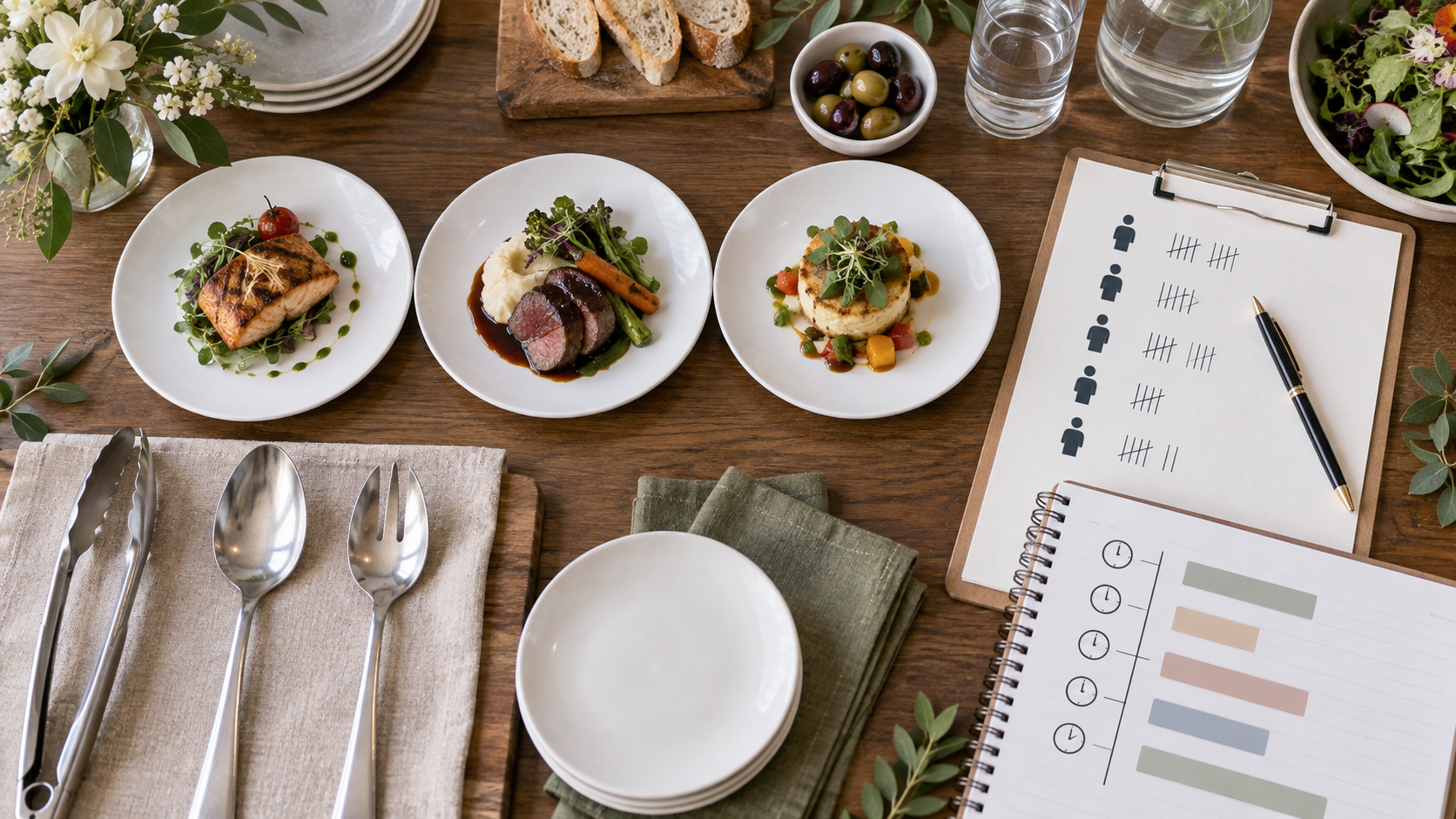
A tasting can help you check flavour, presentation and portions, but clarify what it costs and what it commits you to. The final menu should include the changes you agreed. If an ingredient depends on supply, ask what substitute is possible and how it will be approved.
Treat allergies as an operational question
Ask who receives the information, how the dishes concerned are identified and what steps limit cross-contact. If the caterer cannot guarantee a suitable preparation, they should be able to say so plainly. A “free-from” label or a verbal promise is not enough for a severe allergy; the person concerned must be able to decide with appropriate medical advice.
Also have the caterer specify how food is kept hot or cold, when it will be delivered and who is responsible once the dishes are handed over. This article does not certify any food-safety practice and does not describe the caterer’s regulatory obligations.
Weigh up the invisible service
How many people set up and serve? What time do they arrive and leave? Who brings the tongs, platters, bins, tablecloths and containers? Who clears the tables and puts the space back in order? A more expensive offer can save you hiring equipment separately or roping in friends and family during the event.
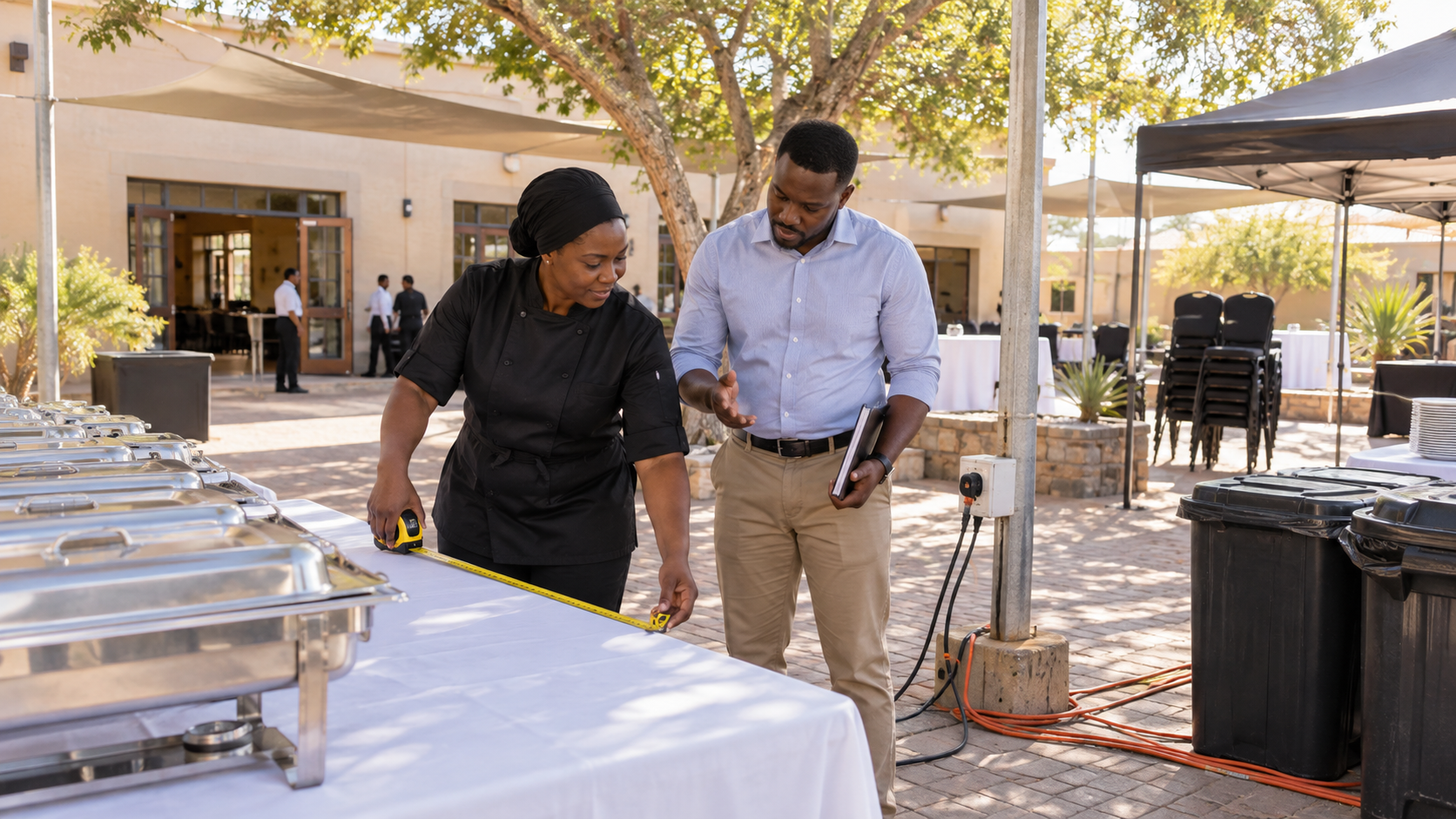
Check access to the venue, parking, how far things have to be carried and which kitchen is available. If the caterer has to cook on site, confirm water, electrical capacity, ventilation and setup time. Any constraint discovered on the day can turn into a surcharge or a reduced service.
Test the scenarios that move the quote
- What is the final deadline for confirming guest numbers?
- What happens if the number goes up or down?
- What extra applies if service finishes later?
- Who pays for breakages or lost equipment?
- How are postponement, cancellation and weather handled for an outdoor event?
- Can leftovers be handed over, in which containers and under whose responsibility?
- If the venue changes or moves further away, how is transport recalculated?
Ask for figures or a calculation rule. “We’ll see depending on the situation” makes it impossible to compare the full cost.
VAT, deposit and a written record
According to the VAT brochure published by the Namibia Revenue Agency (NamRA), VAT applies at the standard rate of 15% to most goods and services. Not every provider is registered, so an amount may legitimately be quoted without VAT. What matters for comparison is that each total says “VAT included”, “excluding VAT” or “VAT not applicable”. If the caterer is registered and you need a document for your records, ask for a tax invoice: the same brochure says it shows, among other things, the supplier’s VAT number, the amount excluding VAT, the VAT and the total including VAT.
Before confirming, write down what is included, what is not, who supplies which materials and how changes will be approved. For the deposit, have its amount put in writing, along with what it secures, when the balance is due and what happens to it if either side postpones or cancels. A message or email restating the accepted quote is a useful record that helps avoid misunderstandings. It is not necessarily the only form of agreement that counts legally, and this guide does not say which form prevails: when a lot is at stake, look carefully at the contract on offer. For more on arranging services with local providers, see our Windhoek local booking guide.
Illustrative example: two quotes for a farm party
This case is invented to show the method; it does not describe a real event or an existing caterer, and it gives no prices.
Sixty guests, a birthday on a farm about an hour and a half from a town, evening service. Quote A is clearly lower. Filling in the grid shows that it covers delivery of cold and hot dishes in containers, with no staff, no ice and no waste removal. Quote B offers a braai cooked on site, three staff until 10 pm, ice and waste removal, but says nothing about VAT or where the team will spend the night.
Before deciding, you need two answers from B (VAT and the team’s accommodation) and a price from A for service and ice. If the host’s friends and family are happy to serve and the farm provides a freezer, A may still be the right choice. If nobody wants to spend the evening behind the buffet, the price gap starts pointing the other way.
The message to send
Hello, we are organising [event] on [date] at [venue], about [travel time] from [nearest town], reached by [tarred road / gravel road], for [number] adults and [number] children. We would like [format] from [time] to [time]. Dietary requirements are [list, separating allergies from preferences]. The venue has [kitchen, electricity, water, cold storage, shelter].
Could you please itemise the menu and portions, staff, equipment, transport, setup, ice, power, cleaning, waste and leftovers, your team’s return trip or accommodation, any possible extras, VAT (included, on top or not applicable), the deposit, the deadline for confirming guest numbers and your postponement and cancellation terms?
Finding caterers on Ayivoo without mixing up categories
On Ayivoo, caterer profiles appear in the Food & Beverage category, alongside restaurants, cafés and bars. Searching for “catering” in that category brings up these profiles, but also self-catering places to stay — accommodation with a kitchen, not caterers. Read each profile before adding it to your shortlist. For the wider organisation of the event, the events and organisation category brings together other types of provider.
In the caterer profiles consulted on 4 October 2026, the price was given as “on request”, so there is no honest basis for publishing an average price or a range here. A profile proves neither availability on your date, nor the area the caterer is willing to cover, nor its hygiene practices. A search that returns nothing only means that no profile matches those terms, not that there is no caterer in your area. If you start searching now, pick two or three profiles close to the venue and send each of them the same message.
Decide with a reasoned score
Once the grid is filled in, rate five dimensions: fit with the brief, clarity of quantities, control of logistics, handling of constraints and contract terms. Weight them according to your event. For an intimate dinner in town, the menu may dominate; for a large outdoor event far from everything, logistics and the fallback plan become decisive.
Before paying the deposit, check the scope, the terms and the cancellation conditions. Afterwards, stay reachable and raise concerns early. If the service changes, go back to a simple structure — what you observed, its practical effect, the solution you expect and a deadline for a reply — and confirm the new agreement in writing. Clear communication protects the relationship as much as the agreement itself.
Frequently asked questions
How do I compare two very different menus?
For two catering quotes with different menus, start with the format, portions, service and full cost. If the proposals still differ, don’t force a ranking on price: choose the one that best serves the main priority of the event.
What should I ask a caterer about allergies?
Ask about ingredients, substitutions, prevention of cross-contact, how dishes are identified and who is responsible on the day. For a severe allergy, the person concerned must judge whether the level of guarantee the caterer offers is enough.
Is the price per person enough to compare catering quotes?
No. To get the full cost of a catering quote, check staff, equipment, transport, VAT, overtime, breakages and cleaning.
Does a catering quote in Namibia include VAT?
Not necessarily. The standard Namibian VAT rate is 15% according to NamRA, but a caterer that is not registered does not charge it. Make sure each quote states “VAT included”, “excluding VAT” or “not applicable”.
What should I check for a caterer at a remote farm or lodge?
Before accepting a catering quote outside town, ask who supplies power, water and ice, how food is kept cold during the journey, whether the team stays overnight or drives back after service, and who takes the waste away.
Does Ayivoo show catering prices?
In the caterer profiles consulted on 4 October 2026, the price was given as “on request”. This guide therefore publishes no average or range; ask each caterer for a quote based on the same brief.
Sources and last check
Checked on 4 October 2026. Standard VAT rate of 15% and contents of a tax invoice: NamRA — Value Added Tax brochure (undated document, read directly; its registration threshold is not used here because it is no longer up to date). Categories, “on request” price labels and search results: public Ayivoo pages consulted the same day, with no published count.
Limits: this guide does not certify hygiene, qualifications, insurance or prices, and does not describe the food-safety or licensing requirements that apply to caterers. No caterer was interviewed for this version. The illustrations do not show a real event, caterer or venue. Ingredients, availability, VAT and terms must be confirmed with the caterer and the venue for your specific event.
Before you sign: read the “distance and return” and “VAT” lines of the quotes you received side by side; if either is still vague, get a written answer before ranking the offers. If you are still missing a third reply, go back to the caterer search on Ayivoo with the same message.